AD (728x90)

  • 2793 Pine St

    2793 Pine St

    Nulla facilisi. Cras blandit elit sit amet eros sodales, non accumsan neque mollis. Nullam tempor sapien tellus, sit amet posuere ante porta quis. Nunc semper leo diam, vitae imperdiet mauris suscipit et. Maecenas ut neque lectus. Duis et ipsum nec felis elementum pulvi...

  • 1100 Broderick St

    1100 Broderick St

    Nulla facilisi. Phasellus ac enim elit. Cras at lobortis dui. Nunc consequat erat lacus, a volutpat nisi sodales vitae. Phasellus pharetra at nulla in egestas. Vestibulum sit amet tortor sit amet diam placerat tincidunt sit amet eget lorem. Phasellus ...

  • 868 Turk St

    868 Turk St

    Nulla facilisi. Phasellus ac enim elit. Cras at lobortis dui. Nunc consequat erat lacus, a volutpat nisi sodales vitae. Phasellus pharetra at nulla in egestas. Vestibulum sit amet tortor sit amet diam placerat tincidunt sit amet eget lorem. Phasellus posuere posuere fel...

  • 420 Fell St

    420 Fell St

    Sed at vehicula magna, sed vulputate ipsum. Maecenas fringilla, leo et auctor consequat, lacus nulla iaculis eros, at ultrices erat libero quis ante. Praesent in neque est. Cras quis ultricies nisi, vitae laoreet nisi. Nunc a orci at velit sodales mollis ac ac ipsum. Na...

Showing posts with label machu picchu. Show all posts

Tuesday, July 19, 2011

Machu Picchu and Galapagos Islands among top destinations.


The South Island of New Zealand emerged the top pick among female adventurers, followed by Machu Picchu and the Galapagos Islands. Male adventurers picked the Galapagos Islands first, followed by Patagonia and Yosemite National Park.

Travelers in the 18-34 age group would like to visit the South Island of New Zealand, the Galapagos Islands and Machu Picchu, whereas adventurers in the 35-54 age group selected Bora Bora, French Polynesia, the Galapagos Islands and Yosemite National Park as their most desired adventure destinations.

Machupicchuk.com is a different sort of website that empowers adventure travelers to discover and book adventure trips directly with the world's leading adventure tour operators, skipping the travel agent.

"Whether you're a horseback rider or trekker, scuba diver or cyclist,we aim to bring you the widest selection of the most exhilarating adventure experiences - so you can focus on finding the trip that's right for you."

After joining via Facebook, users can pick activities and see a map of where they are being offered world-wide. I chose "climbing" and was presented with a map showing organized tours at various locations, complete with a description of what is being offered and a price.

Just for fun, I picked a tour called Everest Base Camp with Island Peak (like I could survive it) and got a quick overview of what to expect along with a detailed description of all that would be happening. Included too were alternative but related tours and resources for further investigation.

This is good stuff to simply kill some time on a hot summer day or get a serious idea of what is involved, when the best time to go is and what costs might involve.

Sunday, July 17, 2011

Machu Picchu Centennial Celebrations ends.

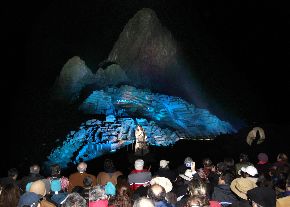
After kicking off the evening with a video showing the key elements of Peru's chief tourist attraction, groups of artists dramatized an offering made by the Incas to gain permission to begin construction of the sanctuary.

They made their offering to the surrounding mountains, believed to be gods in the Andean culture.

Appearing onstage were delegations from the four territories that made up the Tahuantinsuyo, or Inca Empire, bearing torches that lit up the streets and plazas of Machu Picchu.

Projections on the ancient walls then showed the building of the citadel, after which an actor playing the Inca emperor appeared to thank the gods for their wisdom and support.

The show went on to portray the arrival of the Spanish conquistadors, and how it forced the citadel's inhabitants to flee to safer ground.

At this point the evening's most spectacular moment began, a great fireworks display that illuminated the citadel and Huayna Picchu, the mountain that with Machu Picchu forms the background of the most famous photos of the sanctuary.

The show also in included music of the popular "El Condor Pasa," played by the Andean Orchestra and the Cuzco Symphony Orchestra, and sung by Tania Libertad.

The number was followed by other songs including "La Mano Desasida" (The Hand Set Free, from a poem by Martin Adam) and the traditional Cuzco tune "Valicha."

Topping off the show was a man hang-gliding over the citadel imitating the flight of the condor, the region's iconic bird.

The commission responsible for the festivities had been mulling the possibility of staging a large concert at Machu Picchu for months, with Paul McCartney and Peruvian tenor Juan Diego Flores named as possible headliners.

But the government subsequently opted for a less ambitious event with fewer guests after UNESCO, which supervises World Heritage Sites such as Machu Picchu, expressed concerns about possible damage to the famed ruins.

With the change, the guest list for Thursday's night main extravaganza was restricted to government officials and members of state-run media outlets, which afterwards distributed photographs and video footage of the event to the rest of the journalists.

The show was directed by peruvian filmmaker Luis Llosa.

Though Bingham's arrival was really on July 24, 1911, Peruvian authorities celebrated on Thursday the centennial of the discovery of Machu Picchu, celebrations that began in the morning at the sanctuary and also included the city of Cuzco, where the day was declared a holiday.

Wednesday, April 27, 2011

A future in Machu Picchu's past.

It's 10 minutes before dawn and my wife and I are waiting for sunrise in one of the most beautiful places on earth: Peru's Machu Picchu, the mountaintop religious retreat and citadel probably built by the Inca emperor Pachacutec in the 15th century.
The ruins are stunning: temples, altars and palaces of white stone, surmounted by a near 360-degree view of the Andes mountains around us. The only problem? In the midst of all this beauty, we're quarrelling. And, naturally, it's all my fault.
In writing Cradle of Gold, a book about how American explorer Hiram Bingham rediscovered Machu Picchu in 1911 and then fought with Peru over its artefacts, I'd visited the site many times, interviewed its archaeologists, and just sat, enjoying its quiet repose. But because it's my wife's first visit, I wanted it to be special.
I thought we'd get up at 4.45am, have a breakfast of bananas and coca-leaf tea, and then hike the two vertical miles up from Aguascalientes, the town on the river below, in time to see the sun set the Andes aflame. This was what Hiram Bingham did whenever he visited, and we would do the same.
What sounded good over pisco sours the previous evening melted in the daytime. Waking up for breakfast was fine, but about half an hour into the hike I realise the toll that writing my book had left upon my body. Too much coffee, not enough of the trekking I did while living in Peru.
Early bird buses whizz past us on the road. I envy their passengers but proudly refuse to slow down. This irritates my wife, who barely has the time to enjoy the view of the river below and the lush vegetation above.
It takes us nearly two hours of hard climbing to make it – Hiram's best was 40 minutes – and we arrive all but spent. I further fan the flames by hustling her through the ruins to a nice quiet terrace from which we'll watch the sunrise.
As we frostily split an orange, I realise why I've been behaving badly: I want her to love Machu Picchu like I do, but I'm afraid that she won't.
I needn't have worried. She spots it first. Off to the south, the first rays hit the Inca Sun Gate, the final marker of the Inca Trail. The line of sunlight marches along the ridge, illuminating the terraces, and then the golden wave of fire is upon us.
Like the plume of a volcano, the sun flares from between two peaks to our east, sweeping away the clouds, warming our faces, and the old, cold stones beneath us, placed here perhaps 600 years ago, by Pachacutec's workers.
My wife takes my hand. "It's wonderful," she says, glowing.
I add: "But next time, we can take the bus."
When I return to Machu Picchu to escort a tour for tour company Bailey Robinson, I'll be keeping that relaxed resolution intact. July 24, 2011 marks the 100th anniversary of Hiram Bingham's first visit to the ruins, and in the century since it's become easy to explore Peru with less effort than Bingham, and more style than Pachacutec.
Lima – the country's capital and most travellers' introduction to the country – has undergone a renaissance just in the time I've been travelling there. Once the administrative centre of Spain's colonial South American holdings, the city has exploded as a new artistic and culinary capital of the Americas, suffused with its coastal, foggy mix of Andean, Pacific, Asian, African and Spanish culture.
In galleries and cafés, I wait with bohemian film-makers and cognoscenti businessmen for sprawling gourmet lunches of ceviche: seafood "cooked" in lime juice and a Technicolor variety of spicy sauces, served with sweet potato and roasted corn.
Afternoon tours of Lima's colonial cathedral slip smoothly into restaurants like Astrid y Gastón. I still dream about a trio of scallops I ate there on my birthday six years ago – soft and swimming in a perfumed sea of yellow Andean peppers, so fresh that it would have satisfied even Naymlap – a seagoing founder of one of the northern pre-Columbian cultures.
By contrast, Cuzco, the Incas' former capital, is famous for its indigenous heritage. Police halt traffic for the near daily parades of Inca heirs and dancers.
I've spent happy hours haggling with shrewd market women over explosively colourful fruits grown by family members in the countryside. I've spent even more time wandering through Inca temples and palaces that are literally the foundations of the city's most prominent colonial and mansions. As Luis Valcárcel – who challenged Bingham's export of artefacts to Yale University – once said, Cuzco is "the only city of America where all time periods and civilisations exist".
Yet one of those time periods is decidedly modern. International jet-setters wander from their hotels to some of Peru's most interesting Andean restaurants. Stomachs full of peppered alpaca and guinea pig-topped causa – a multicoloured tower of spiced, mashed potato – they then explore rich museums of pre-Columbian archaeology and art, glowing in the high-altitude night.
Those museums are about to get even more interesting. Peru and Yale recently announced that by July the university will be returning to Cuzco a first batch of skulls, bones, ceramics and silver that Bingham excavated and exported from Machu Picchu in 1912.
Finally, there's the main event: Machu Picchu itself and the Sacred Valley leading up to it. Two hours from Cuzco, the stunning vistas of the Sacred Valley – waving corn fields beneath soaring Andean peaks – now include spas and retreats. Peasant
co-operatives sell near-couture quality textiles to travellers on their way to Ollantaytambo, the fortress where the rebel Inca emperor Manco temporarily fought off the Spanish in 1536.
Visitors then take a route that Manco avoided: along the winding, roaring Urubamba river and precipitous jungle-covered cliffs that guard Machu Picchu. Bingham first went by mule, but when he returned in 1948 to inaugurate the road up to the ruins he took the train. Today, PeruRail even offers a luxury option, the fittingly named Hiram Bingham, which rolls along with brass railings and a bar-car that harks back to the golden age of rail travel.
Peru: essential travel information
No matter how I get there, however, Machu Picchu never fails to make me smile, as it did my wife. White stone, green and black peaks, blue sky, meeting in a citadel now crucial to Peru's future: a spiritual indigenous core, inspiring new ideas about Peru's history and way forward.
It's a lesson that Peru teaches every visitor: there are many cosmopolitan modernities in the world and we need to keep our minds open lest we dismiss them as exotic, hard-to-reach places. In Peru, the future is narrated in Andean-inflected Spanish, thrives in a well-preserved, once-imperial ruin, and, yes, is reachable by bus.

Christopher Heaney is the author of 'Cradle of Gold: The Story of Hiram Bingham, a Real-Life Indiana Jones, and the Search for Machu Picchu', published on July 24 (£11.99, Palgrave Macmillan).
He will escort an anniversary tour of Machu Picchu from July 20-26, bookable with Bailey Robinson (see 'Essential travel information line, above').

Tuesday, February 15, 2011

Along to Machu Picchu, Peru promotes eight tourist destinations.

Peru's tourism minister announced a new campaign to promote eight new tourist destinations besides the famous Inca sanctuary of Machu Picchu, Perú21 reports. The new sites were selected to help visitors discover the country’s culture and biodiversity.

What we are looking for are destinations that complement Machu Picchu, not substitute for it,” Ferreyros explained in an international press conference in Lima.

The destinations at that the ministry for tourism seeks to promote are “Ruta Moche,” cradle of the ancient civilizations of the northern coast; Paracas and Nazca, on the southern coast; Lima as a culinary capital; the northern beaches; the Amazon river; the Colca Canyon in Arequipa; the department of Cusco; and Lake Titicaca.

But the minister explained that promoting these sites will involve work on the part of many different sectors, and expected results will be long term. He said that it will be necessary to improve transportation, utilities and hotel services in the target destinations.

Machu Picchu, which celebrates the centennial anniversary of its discovery this year, does not need further promotion according to the minister, as it receives some 2,500 daily visitors. Studies to determine an appropriate number of tourists who can visit the site without causing adverse effects are currently ongoing, and will conclude this April.

Friday, January 28, 2011

Traveling to Machu Picchu


Machu Picchu is the pre Columbian, Inca empire site that is located almost 8,000 feet above the sea level. The site is located on a mountain ridge above the valley of Urubamba in Peru. The city is also called the “lost city of Incas”. When tourists make a list of the best world tour destination, Machu Picchu is the site that undoubtedly gets the maximum number of votes.

It is said that the journey to this spot is a dream journey, which one must never miss. It is a journey to the top archeological site on the planet earth. Data says that the Machu Picchu Tourism is one of the proudest industries in the country. Whatever your expectation out of the place would be, you will really be more than delighted to see the picturesque beauty of the place and the intoxicating power that it will have on you.

Machu Picchu was built in 146 AD, however, it was left by the Inca rulers 100 years later. Legendary stories suggest that the place was neglected for quite some time. In the year 1911, Hiram Bingham, who was an American historian, got the world’s attention to it and then there was no looking back. Recent discoveries also show that the site was dug many years ago by a German businessman. The site became a part of the UNESCO, world heritage site in 1983. The site as built in typical Inca style with dry stone polished walls and it most famous buildings are ‘ the temple of sun’ and ‘ the room of three windows’.

Traveling to Machu Picchu
The site is located 80 kilometers northwest of Cusco and sits between two mountains. From Cusco, you can take a train to Aguas Calientes and then take a bus up to the actual site. If you are of the more adventurous type, you may want to take a one-way bus trip up to Machu Picchu and then walk down to Aguas Calientes on your way back.

Wednesday, October 27, 2010

500 mil chilenos gastarán US$ 450 millones en turismo

Este año visitarán Perú alrededor de 500 mil turistas chilenos, los cuales gastarán 450 millones de dólares en el país, con lo que Chile es el principal emisor de turistas hacia el mercado peruano en la región de América Latina, afirmó hoy el Ministerio de Comercio Exterior y Turismo (Mincetur). El ministro de Comercio Exterior y Turismo, Eduardo Ferreyros, indicó que la cifra prevista para este año superará a los 450 mil turistas chilenos recibidos en 2009 pese a los efectos de la crisis internacional.
Agregó que los visitantes chilenos que llegaron el país el año pasado, y que dejaron divisas por 390 millones de dólares, ingresaron por la frontera entre ambos países y el Aeropuerto Internacional Jorge Chávez.
"El turista chileno que entra por la frontera sur de Perú deja entre 150 y 200 dólares por día; mientras que el que arriba por el aeropuerto Jorge Chávez deja de 850 a 900 dólares, lo cual incluye hotel, consumos y otros."
Precisó que alrededor de 60,000 visitantes ingresarían por el aeropuerto Jorge Chávez y la diferencia por la frontera, los cuales pueden seguir su viaje a zonas turísticas de Cusco, Puno y Arequipa.
"El chileno tiene capacidad de consumo y encuentra en Perú no sólo la posibilidad de hacer el típico turismo cultural histórico, sino que hay mucho turista que entra por la frontera para utilizar los servicios médicos."
Ferreyros declaró luego de inaugurar un desayuno de trabajo entre operadores turísticos que se desarrolló en el marco de la Expo Perú, que concluye hoy en Santiago de Chile.

Monday, October 18, 2010

UI students travel to developing countries

A six-day trek to Mount Kilimanjaro or hike on the Inca trail to Machu
Picchu this summer can help children in developing countries.

Childreach International is offering similar opportunities for
University students to travel abroad to help improve health care,
education and child-protection rights in developing areas.

The two challenge trips — a trip where participants must raise
thousands of dollars to attend — offered this summer are traveling
abroad to Tanzania and Peru. Amanda Leibovitz, director of fundraising
for Childreach, said the trip is an amazing opportunity for young
adults to reach out to those in need.

Leibovitz said the trip is appealing to students because only $250 is
contributed out of their own pockets. The rest of the costs —
including traveling, accommodations and food — are accumulated by
fundraising, with 50 percent of the funds going directly to the
community project. Most of the projects focus on keeping children in
the education system through building schools and vocational training
centers.

Childreach also has what they call a Future Builder program, which
takes 14 students abroad to help construct or renovate a specific
project within a developing community. Leibovitz related this trip to
something like what the organization Habitat for Humanity does.

Laura Snyder, senior in LAS and an on-campus intern for Childreach,
has been marketing and promoting the opportunity across campus. She
said working with Childreach has been a very rewarding experience.

"I'm hoping to go on one of the trips myself in order to get that
personal growth and reward this summer," Snyder said. "And not only
does it personally feel good, but it feels great that my work is going
toward the children in third-world countries to better their lives."

Caitlin Miles, junior in FAA, said she has been looking for an
opportunity just like this one.

"I'm just really interested in helping people," Miles said. "I really
was interested in doing something to help children anywhere this
summer and I got an e-mail about this and I was really excited because
it's helping children and that's what I wanted to do."

Leibovitz said other universities they've been recruiting at have been
more receptive to the idea of offering college credit hours for this
study abroad opportunity. The University currently does not offer
credit, but she said that they still want to try and open that door
for University students.

"It's a great opportunity, for young people in America to go out for
not much out of their own pockets and get really involved in their own
community and to have that cultural exchange," Leibovitz said. "I
think it really makes for a well-rounded individual and gives them a
lot more opportunities in life."

Inca Trail Tails: A journey to Machu Picchu

It's easy to say that until you have set foot onto the hallowed
grounds of Machu Picchu, that you cannot truly imagine such beauty,
such grandeur, or such a heavenly ambiance in one natural setting; an
ambiance that still ranks high on my list given the other sense-awing
vista areas to which have traveled in other parts of the Andes
Mountains.

In the case of this four-day and three -night venture (which forms the
typical Sacred Valley to Machu Picchu trip via the "Inca Trail"), few
of my previous trekking adventures would stand up to the magnificent
sights, heartfelt laughs and memorable experiences lived here on the
road to the "Old Mountain," the English translation of Machu Picchu.

At 5 a.m. sharp, each of the 15 groups rose like eager troops ready
for their mission impossible into unknown terrain. Like clockwork, our
group of 12 prepared, ate and promptly left the campsite at the
Trekker Lodge. The anticipation was palpable as we strode along the
jungle trail, moist in all directions from ground to the low-hanging
and all-encompassing foliage. Most everybody on the trail was chomping
at the bit to arrive first at the mountain pass, or "Sun Gate," at
which point the 15-minute coast down to the Machu Picchu ruin site
would be only a formality. Anxiety, stress and haste colored the mood
up to the mountain pass, while peace, serenity and stillness awaited
us at our arrival to the Sun Gate.

It's as if a collective exhale sounded off as the slow herds of hikers
trounced upon the nest-like entrance. From there, with the Sun Gate
arch anciently accenting the threshold between desolation and
civilization, between lost and found, and between uncertain and
certainty, this divine view inspired each soul to cede to its surreal
and inescapable grace.

Luckily for us, today was a perfect day to be here: a few passing
clouds, a slight breeze and unmatched company. In that instance, we
could see each aspect of the ruin site that lay below. The first
observation made: the inseparable union of Machu Picchu (the citadel)
and Huayna Picchu (the back-dropping mountain). After that, the rest
just happens: the various courtyards, temples and structures stretched
over and molded to the Old Mountain, the outlying and ubiquitous
verdant mountains that surrender to a fate unseen and abysmal in the
river basin far below, and the timeless and tranquil quality to all
the eye and heart sees.

When present here, one imagines the mighty toil expended in executing
such an architectural endeavor. Though, keeping in mind that Machu
Picchu was a later Incan construction, this project might not have
been considered large by the standards of the Incas who, especially
during the time of the Inca Pachacuti (14th century), were enormously
prolific and ambitious, architecturally speaking and otherwise.
Regardless of the mindset of the architects and workers of Machu
Picchu, any attempt to understate the site's divinity would be
atrociously futile.

When present here, one imagines the mighty toil expended in executing
such an architectural endeavor. Though, keeping in mind that Machu
Picchu was a later Incan construction, this project might not have
been considered large by the standards of the Incas who, especially
during the time of the Inca Pachacuti (14th Century), were enormously
prolific and ambitious, architecturally speaking and otherwise.
Regardless of the mindset of the architects and workers of Machu
Picchu, any attempt to understate the site's divinity would be
atrociously futile.

Patrick Roseblade is an author and freelance writer in South Lake
Tahoe. He has traveled extensively through Spain and the Andean
countries of Peru, Ecuador, Bolivia and Colombia. He holds a bachelors
degree in cultural anthropology from UC Davis. His collection of
travel essays is at perupat.blogspot.com.

Endhiran The Robot : First Indian movie to shoot at Machu Pichu

The word 'impossible' does not exist in Rajinikanth's films and it is
proved again. Rajinikanth's latest movie Endhiran has been shot at
Machu Pichu, the protected heritage site in Peru. It has become first
Indian movie to be shot in this exotic location.


Earlier, the bosses of Hollywood movie Quantum of Solace wanted to
shoot at this place. But the Peruvian government had denied them
permission. Now, many Hollywood and Bollywood filmmakers have been
left with wonder after Rajini's movie got permission to shoot in this
location.

However, very few films have been shot at this pre-Columbian Inca
site. Secret of the Incas, The Motorcycle Diaries are the some movies,
which had got permission to capture this Historical Sanctuary.

The song 'Kilimanjaro' featuring Rajinikanth and Aishwarya Bachchan
was shot at Machu Picchu. Sources say that Indian High Commission
helped director Shankar in getting permission from Peruvian
government.

Sunday, October 17, 2010

Celebrates its 100th Birthday of Discovery

Visiting Machu Picchu is now on everyone’s to do list during their Peru vacations this year thanks to the Birthday of the Inca city coming up this July. One of the preferred methods of getting to the city is of course the Inca trail.
Online PR News – 01-April-2011 –Visiting Machu Picchu is now on everyone’s to do list during their Peru vacations this year thanks to the Birthday of the Inca city coming up this July. One of the preferred methods of getting to the city is of course the Inca trail. The Inca trail is a widely traversed route to the ancient lost city of Machu Picchu. It is a highly popular trail for visiting tourists; this is in part due to the appeal from taking a route that was the traditional one used by the Inca.
The Inca trail can begin after you visit the beautiful city of Cusco; it is a great alternative to the more common train rain from Cusco to the ancient Inca city. While both methods are scenic only one allows you to sleep under the Andean night sky as well as hike through the Peruvian highlands for 3-4 days. The views are outstanding; passing by glaciers, unique flora and fauna. The local landscape is unlike anywhere else in the world and the weather is an ever changing one. This can add to the challenge of going through the trail before finally ending up in time for your Machu Picchu tours which will be guided by a professional, bilingual guide of course.
The Inca trail is considered an easy to moderate trail which can be taken by pretty much anyone willing to camp out for a few days and sleep in the Andean wilderness over night. It is definitely you should try to include into your Peru vacations and Peru travel packages. The tour in Machu Picchu will definitely put the icing on the cake during your vacation. Now there are special deals going on in reference to Machu Picchu tours which are being offered by a few agencies wanting to promote the city for the 100th birthday of the discovery of Machu Picchu by Hiram Bingham; there are great rates on all Peru services out there at the moment.
Come celebrate the centennial of Machu Picchu by taking part in the celebrations which are scheduled to take place from special tours to a final special celebration which will be filled with special guests. Contact your Machu Picchu tours provider now and ask what special events you can take part in during this very special time in Peru.

Machu Picchu artifacts are carefully identified and recorded

Every single Machu Picchu piece returned by Yale University has been carefully identified and recorded by archaeologists and historians in an inventory, the Press Secretariat of the Presidency of the Republic announced on its Twitter account.
The unpacking of the artifacts was made by specialized staff members of the Culture and Foreign Ministry gathered at Government Palace.

The relics, which were taken out of the country 100 years ago on a loan basis, remain at the Main Dinning Room of the presidential palace.

The opened crates contain large ceramics such as aryballos, vessels, and skeletal remains among others.

These artifacts belong to the first batch that were taken by US explorer Hiram Bingham in 1912 to Yale University in order to study them.

The 360 pieces, packed in some 30 wooden crates, arrived Wednesday at Jorge Chavez International Airport. Afterwards, the artifacts were escorted by some 600 police officers to the Government Palace.

Sunday, October 3, 2010

Machu Picchu, Peru: Anchient Andes city is Picchu perfect

Hiram Bingham and the Lost City of the Incas - not as snappy or famous
as Indiana Jones and the Last Crusade. But it's absolutely true, a
real-life archaeological adventure in the South American jungle.

One hundred years ago next July, American explorer Bingham made the
sensational discovery of Machu Picchu, the deserted mountaintop Inca
city near Cusco, high in the Peruvian Andes.

Of course, getting to Machu Picchu is an awful lot easier today,
either by walking the four-day Inca Trail - which my 3am colleague
Clemmie Moodie has been heroically tackling this week - or by train. I
joined the Vistadome train at Ollantaytambo in the Inca Sacred Valley
near Cusco.

It's a splendid blue train, with huge viewing windows, that takes a
couple of hours to reach the station at Machu Picchu Pueblo.

Then it's on to a bus to the Inca city itself via a rather twitchy
ride that climbs into the mountains on a series of alarmingly tight
hairpin bends.

You finally arrive at the lost city, and what a glorious view it is.

It truly is one of life's must-see places. I was so awe-struck I just
stood staring and snapping away with my camera.

Finally, it's time to head in to the city itself to explore and wander
around in the centuries-old footsteps of the Incas. If you are
visiting Machu Picchu it's a racing certainty you will spend some time
in Cusco, the chief city of the region.

Perched at a lofty 11,200ft, it merits a few days' visit to
acclimatise to the altitude. I stayed at the Hotel Monasterio, which
offers oxygen piped into your room to assist with the adjustment.

Cusco is a captivating city, there's a feel that you're in somewhere
otherworldly in what is a dusty high-altitude Andean bowl dripping
with Incan heritage and Spanish colonial architecture. It's a
boisterous place too. As the starting point for trips to Machu Picchu
by both rail and foot on the Inca Trail, it's a magnet for tourists of
all ages and very much a thriving regional capital.

Before heading to Machu Picchu I stayed at the Tambo del Inka Hotel in
the Sacred Valley, a fine spa resort made remarkable by the size of
the public rooms.

They are quite simply ENORMOUS. The LA Lakers basketball team would
feel utterly lost in the huge foyer. But they would be just as
impressed as I was by the view from it at sunrise as the first pink
rays hit a lofty Andean glacier.

And who could not be moved by the sight of the night sky in this
valley? As I strolled through the gardens a shooting star caught my
eye as it flashed across the night sky. Only then did I fully
appreciate the majesty of the constellations at this altitude with no
light pollution.

Q&A: Best Route to Machu Picchu

I'm planning a trip to Machu Picchu in late September and early
October. I'm interested in making this a safe but adventurous trip. I
will be traveling to Peru with my adult son. Neither of us speaks
Spanish.

First, it's important to note that Machu Picchu has imposed a daily
limit on the number of trekkers to the site. This means it's essential
to plan well ahead. That said, the famous Inca ruins can be reached in
several ways. The easiest and most common route, but still
adventurous, is by train from Cuzco (a 20-minute taxi ride to Poroy
station) to Aguas Calientes (allow a day or two in Cuzco to
acclimatize to the altitude).

From there, you can take one of the three train options, each taking
less than four hours: the affordable Expedition; the faster,
first-class Vistadome; and the expensive and luxurious Hiram Bingham.
Make your train reservations as early as possible, especially for the
high season, which runs from May to October (www.perurail.com). From
Aguas Calientes you can take a short bus ride up switchback roads to
the ruins, or if you can, hike this last part along a steep path,
which takes over an hour, or take a bus up and then hike down. To
appreciate the ruins fully, stay overnight outside Machu Picchu or
down in Aguas Calientes.

For a more intense trek, you can pick one of two main hikes along the
famed Inca Trail: the rigorous four-day, three-night route or the less
demanding two-day, one-night route. The trails begin outside the
nearby town of Ollantaytambo — trekkers arrive there by train (above)
or bus from Cuzco. Frommer's, the online content partner of the Travel
section, warns that "you must go as part of an organized group
arranged by an officially sanctioned tour agency." Frommer's also
suggests making reservations at least three months ahead for the high
season (May to October). You can return to Cuzco or Ollantaytambo by
train.

Friday, October 1, 2010

Inca Adventure starting from $990

Explore Machu Picchu with a guided tour
Calling all explorers and adventurers! Machupicchu2RS.com is featuring
an "Inca Discovery" trip which takes travelers into the heart of Peru.
Spend eight days in Peru and take a guided tour of Cuzco, Sacred
Valley, the Inca Trail and Machu Picchu. Prices start at $990 per
person and tons of departure dates are available.
Your adventure begins in Lima and goes on to Cuzco. In Cuzco, meet
your guide and check into your hotel. The next day you will travel
with a local guide through the Sacred Valley where you can experience
the Inca ruins of Ollantaytambo. Days 4-7 are spent on the ancient
Inca trails. If you love hiking, you'll be amazed by the views on your
way to Machu Picchu. You'll return to Cuzco by train and depart at any
time for home.
Book your trip directly through Machupicchu2RS.com. Our company pairs
travelers up to keep the costs down. Private rooms are available, but
be sure to read the terms and conditions before booking.
You'll need to get yourself to Lima before you can start your
adventure. Here are some affordable flights to get you there:
These deals and sample fares were priced at time of publish.  Prices
may be subject to additional fees and taxes.
New York City flights to Lima from $431
Las Vegas flights to Lima from $459
Miami flights to Lima from $502
Los Angeles flights to Lima from $466
Boston flights to Lima from $644

Contest marking Machu Picchu's discovery anniversary.

Peruvian President Alan Garcia has launched an international contest
of poem, video and prose commemorating the 100th anniversary of Machu
Picchu's rediscovery by Hiram Bingham on July 7th 2011. "Peru's
government makes the announcement of the international contest,
promising to award each field with 3 prices," he added.

Garcia said that the contest will be promoted through Peruvian
embassies in foreign countries and important universities around the
world.

He referred that Cusco citadel had "an enormous impact on Pablo
Neruda's musicality and view" reflected in his tenth book of poems
"Canto General" allowing the Peruvian wonder to be known by poetry.

Likewise, he proposed mayors and authorities of the other world's
wonders to come to Peru next year for marking this important date.

Fearne Cotton on the trek with Denise Van Outen

The telly babe has just scaled the Inca Trail in Peru and cannot
contain her delight.

She might have camped in sub-zero temperatures, hiked over snow-capped
mountains then faced the sweltering heat of the rainforest, but when
she calls to let us know she's reached the top, Fearne is full of
beans.

"We did it," she squeals. "We reached Machu Picchu. It was the most
magical place on Earth.

"There were tears, tears and more tears. We all had the biggest group
hug at the Sun Gate.

"The trek was incredible. I need a shower and a hairbrush so bad, but
besides that we are all on top of the world!"

Fearne was joined by Denise Van Outen and Amanda Byram, both 36,
Gabriella Cilmi, 18, Alexandra Burke, 22, and six women who have been
diagnosed with breast cancer.

They took on the gruelling nine-day challenge of climbing 13,000ft
above sea level to reach Machu Picchu, the Lost City of the Incas, to
raise money for Breast Cancer Care.

But Fearne, 29, admits it was no easy thing to do.

"I underestimated the mental strength you need," she says. "But I
enjoyed the challenge. I know I'll feel depressed when it's over. Our
six incredible women were an inspiration.

"Still, we've got one last day in Peru to explore. I've already bought
so many hats and ponchos."

There will be no time for relaxing when Fearne gets back home. Not
content with DJing for Radio 1, launching her own fashion range,
captaining a team on ITV2's Celebrity Juice and hosting her own Fearne
And… show, she's also penned a book with best pal Holly Willoughby,
29, and is gearing up for her own make-up range to be launched at
Boots in time for Christmas.

But while most celebs would be cursing their agent for setting up so
many time- consuming projects, Fearne couldn't be happier.

"It's been very busy," she laughs. "But I would be bored if I wasn't
busy. It's been a good year of opportunities.
"I've been filming, I'm making a new Sky One series, plus another
documentary series.

"I recently did the iTunes Festival and I have a make-up range coming
out at Christmas.

"And it seemed natural for me and Holly to do the book together
because we are genuinely best friends. We're on TV together but we're
friends first and foremost.

"I'm really happy right now."

Fearne, who was brought up in Pinner, north-west London, started
presenting aged just 17 after winning a talent competition.

In 2003, she moved over to mainstream TV, working on shows including
Top Of The Pops, Love Island and The Xtra Factor. Then in 2005 she
started working on Radio 1 and was last year promoted to the high-
profile mid-morning slot.

Most recently she's also presented Sky One's Must Be The Music.

She is also on top of the world for another reason – she has just got
engaged to her on-off boyfriend, American skateboarder Jesse Jenkins,
24, and says this time it's for keeps.

Fearne reveals: "I'm really excited. But I don't want to say any more
about it as Jesse and I really want to keep our relationship as
private as we possibly can.

"I always used to go for bad boys. I think I was really square so I
wanted to live through them. "I wanted moody, cool boys who wore black
– the wretched artist who likes music, poetry, all that crap. "But
once you're over 25, hopefully you've learned to love yourself a bit
more and decided that you are too good for the lot of them.
"Eventually you realise all you want is someone nice, someone who is a
good laugh, someone to have a family with."

But babies aren't on the cards quite yet. Fearne says: "The pressure's
on to settle down but there are things I want to do first. "I'd like
to travel around South America. I want to get a few more selfish bits
of my life done, and then I'll be ready for it."

Peru edition of Monopoly goes on sale today

The board game includes 22 representative landmarks from Peru, many of
them archaeological sites such as the Nasca Lines, Chan Chan, Chavin
de Huantar and Sacsayhuamán. The Peru edition's most expensive square,
occupied by Boardwalk in the classic version, is Machu Picchu.

The locations were selected during an online voting process during
March. Out of 60 options, the 22 places that received the most votes
made it on the board. Machu Picchu won with 25,919 votes, while the
Nasca Lines came in second with 16,461 votes.

Cards from the game's Community Chest include "You rent Machu Picchu
for a private party. Pay one million." (The currency is not in soles,
but rather a generic denomination, as in all of Monopoly's foreign
editions.) Another reads, in Spanish, "Your potato harvest is exported
to Europe. Receive two million." Meanwhile, a Chance card reads
"Trapped in the center during rush hour. Go back three spaces."

Hasbro says that the game will be sold all throughout Peru.

Machu Picchu Welcomes Rajnikanth (and India)

Strictly speaking, we're talking Kollywood not Bollywood, even if the
latter has become the catch-all term overseas for all movies coming
out of India. "Endhiran" (Robot), in which Tamil megastar Rajnikanth
plays a scientist and a robot and which opens Friday, flew its stars
to Peru to film one of the music scenes.

Fernando Astete, director of the Machu Picchu Archaelogical Park,
recalled the shoot approximately two years ago, remembering in
particular a younger female star (Aishwarya Rai Bachchan, we're
assuming), and an older white-haired woman who did the actual singing.

"We have seen some Indian movies here," said Mr. Astete. "It was the
quintessential music that we see in those movies, with the man falling
in love and courting the woman. There were also some Brazilian
elements all mixed in. It was something quite exotic."

Press photos on the official site show extras wearing feathered
outfits and elaborate metallic head-dresses. Watch a video that
purports to be of a rehearsal at the ruins:

The anthropologist said it was quite unusual to get a film crew like this.

"Normally we get films about the discovery of Machu Picchu, the
Discovery Channel, what was Machu Picchu like, films by National
Geographic, that kind of thing," said Mr. Astete.

"The idea was to promote Peru in the vast market of India,"  he said.

Although the filming was restricted to open areas that may have been
used for agriculture by the Incas, you can see the monument clearly in
the background, he says.

The Incas were brutally conquered in the 16th century by the Spanish,
who made Peru one of the capitals of their empire, and sent a steady
stream of gold and silver from the country to Spain. But Machu Picchu,
also known as "the lost city of the Incas," was never discovered by
them and so never plundered. It was brought to international attention
by Yale historian Hiram Bingham in 1911.

Mr. Astete said the agency that markets tourism to Peru, Promperu,
helped the film's crew with the paperwork in order to be able to film
there.

Peru isn't the easiest place for Indians to get to and vice versa.
There are no direct flights and so air travel time easily totals 30
hours one way. Trade between the two countries stands at only around
$1 billion.

Still Peru is trying, first by winning over movie stars. In April
2009, Deepika Padukone was a guest of Peru for a fashion event
organized by Promperu.

We're all for increased ties between India and Peru, particularly if
India's bureaucracy could learn something from Peru's. At 9 a.m. their
time, government cultural offices in Cusco, the city nearest to Machu
Picchu, were manned. In less than 15 minutes, the first person we
spoke to had figured out mwe should talk to about recent shoots at the
archeological site and provided us the necessary mobile phone number.
The park director answered his mobile on the first try.

At the end of the interview, Mr. Astete also asked a question.

"The movie is coming out this Friday you say?" he said and paused. "Do
you think it would be possible to send us the DVD?"

Friday, April 2, 2010

Beatle Paul Mccartney Set For Machu Picchu Celebrations?

Sir Paul Mccartney is in negotiations to help Peru celebrate the centenary of the discovery of the country's famous Machu Picchu citadel - with a historic Lima show.

Sources claim negotiations to bring the ex-Beatle super star to Peru are going well, and a concert at Monumental Stadium is expected at the end of May (11) as the nation prepares to celebrate the 100th anniversary of explorer Hiram Bingham's discovery of the forgotten ruin.

Meanwhile, Colombian promoter Juan Ospina has revealed that plans for a 2011 McCartney show in Colombia have fallen through.

Ospina says, "He will not arrive in Colombia, but I just got the scoop that he will be playing at Monumental Stadium in Lima and the National Stadium in Chile. Then, he will perform two shows in Maracana Stadium (in Brazil)."

Meanwhile, the president of the Board of the National Tourism in Peru, Carlos Canales, has confirmed a MCCartney concert will be a part of the celebration of the centenary of Machu Picchu's discovery.

McCartney has yet to confirm it.

Saturday, January 9, 2010

Inca success in Peruvian Andes -'Llama dung?'

Machu Picchu, the famous Inca city set in the Peruvian Andes, celebrates the centenary of its "'discovery" by the outside world this July.

Dignitaries will descend on site for a glitzy event in July marking 100 years since US explorer Hiram Bingham came upon the site, but the origins of Machu Picchu were far less glamorous.

According to a study published in archaeological review Antiquity, llama droppings provided the basis for the growth of Inca society.


Llamas have left their mark - literally - on history
It was the switch from hunter-gathering to agriculture 2,700 years ago that first led the Incas to settle and flourish in the Cuzco area where Machu Picchu sits, according to the study's author Alex Chepstow-Lusty.

Mr Chepstow-Lusty, of the French Institute of Andean Studies in Lima, said the development of agriculture and the growing of maize crops is key to the growth of societies.

"Cereals make civilisations," he said.

Mr Chepstow-Lusty has spent years analysing organic deposits in the mud of a small lake, "more of a pond really," called Marcaccocha on the road between the lower-lying jungle and Machu Picchu.

His team found a correlation between the first appearance of maize pollen around 700BC - which showed for the first time that the cereal could be grown at high altitudes - and a spike in the number of mites who feed on animal excrement.

They concluded that the widespread shift to agriculture was only possible with an extra ingredient: organic fertilisers on a vast scale.

In other words, lots of llama droppings.

Llamas' legacy
Llamas were and still are commonly used in the Peruvian Andes to carry goods and provide meat and wool.

Marcaccocha is situated next to an ancient trade route, and llamas transporting goods between the jungle and the mountains would stop to have a drink and "defecate communally".

"This provided fertiliser which was easily collectable as today by the local people for the surrounding field systems," Mr Chepstow-Lusty said.


Llama droppings are still used for crop fertiliser and cooking fuel
As the Incas moved from eating wild quinoa to maize, which is higher in calories, their society developed in the Cuzco area.

Some 1,800 years after they first moved from hunter-gathering to agriculture, around 1100AD, a bout of prolonged warmer weather allowed the civilisation to really flourish, leading to the building of large stone settlements like Ollaytaytambo and Machu Picchu.

Today, the Incas are long gone, largely wiped out by the Spanish conquistadors in the 1500s. But their descendants, the Quechua, still use llama droppings for fertiliser and cooking fuel.

"The valley is full of indigenous people who follow that way of life from 2,000 years ago," said Mr Chepstow-Lusty.

When the guests arrive in Machu Picchu to celebrate 100 years since Hiram Bingham brought it to the world's notice, they can perhaps thank the humble llama for the sight they see before them.

Feature (Side)

© 2013 . : : Machu Picchu : . All rights resevered. Designed by Templateism