AD (728x90)

  • 2793 Pine St

    2793 Pine St

    Nulla facilisi. Cras blandit elit sit amet eros sodales, non accumsan neque mollis. Nullam tempor sapien tellus, sit amet posuere ante porta quis. Nunc semper leo diam, vitae imperdiet mauris suscipit et. Maecenas ut neque lectus. Duis et ipsum nec felis elementum pulvi...

  • 1100 Broderick St

    1100 Broderick St

    Nulla facilisi. Phasellus ac enim elit. Cras at lobortis dui. Nunc consequat erat lacus, a volutpat nisi sodales vitae. Phasellus pharetra at nulla in egestas. Vestibulum sit amet tortor sit amet diam placerat tincidunt sit amet eget lorem. Phasellus ...

  • 868 Turk St

    868 Turk St

    Nulla facilisi. Phasellus ac enim elit. Cras at lobortis dui. Nunc consequat erat lacus, a volutpat nisi sodales vitae. Phasellus pharetra at nulla in egestas. Vestibulum sit amet tortor sit amet diam placerat tincidunt sit amet eget lorem. Phasellus posuere posuere fel...

  • 420 Fell St

    420 Fell St

    Sed at vehicula magna, sed vulputate ipsum. Maecenas fringilla, leo et auctor consequat, lacus nulla iaculis eros, at ultrices erat libero quis ante. Praesent in neque est. Cras quis ultricies nisi, vitae laoreet nisi. Nunc a orci at velit sodales mollis ac ac ipsum. Na...

Showing posts with label peru. Show all posts

Wednesday, July 21, 2010

Erik Weihenmayer Climbs Alpamayo

Alpamayo is a 19,511 foot tall, snow capped peak in the Cordillera Blanca mountain range of the Peruvian Andes. It is a very prominent peak in the area, and is widely considered one of the most beautiful peaks in the world. It was for all of those reasons, and more, that Erik Weihenmayer and his climbing partner Eric Alexander, recently made the trip to Peru to attempt the mountain. 


Erik shared the details of the climb on his blog, which included some great photos of the trip and the video below. The trip involved a 2-day trek to BC, which is located at 14,500 feet, and establishing an intermediary camp at 16,000 feet before going to the summit. The two men had to work in rain and snow, and some technical portions of the climb, but eventually they stood on top. The story of their climb is a good one though, with lots of challenges to overcome along the way.


This climb marks the first blind ascent of the mountain. As many of you know, Erik is the first person to climb Everest without the use of his sight, and has since added the rest of the Seven Summits, including Carstenz Pyramid. He's also scaled El Cap in Yosemite and Mt. Kenya in Africa, amongst plenty of other peaks. 


Thursday, February 25, 2010

7 Scary Hikes Caught On Video

Travel blog Gadling.com, for which I'm a contributor, has a great post up today of 7 of the craziest, most dangerous hikes in the world. Each of the hikes on the list features some common denominators, namely they mix in a bit of altitude with a trail that is a bit on the dangerous side. But describing them wouldn't do them much justice, so thankfully, each of them is caught on video, so we understand exactly why they earned the moniker of "crazy".

A few of the hikes we've talked about here before, such as the El Caminito del Rey and Mount Hua in China. Others were completely new, but well deserving of making the list. One of the videos is embedded below so you have an idea of the level of scary we're talking about here. This one is from the top of Winay Picchu, a peak that actually looks down on Peru's famous Machu Picchu. The views look stunning, but watch that last step...

Thursday, February 11, 2010

Inca Trail Shut Down Thru March


A few weeks back there was a story about how 1300 tourists were trapped at Machu Picchu following massive flooding in the area that destroyed the railway into the ancient mountain top fortress. At the time, we were told that more than 40 landslides covering the tracks and that it was damaged in multiple locations, which was preventing the famous tourist train from reaching those trapped on site.

Yesterday, I wrote an update on the situation for Gadling.com with news that the train is set to resume operation within the next three weeks, which is ahead of the eight weeks that were originally projected. Meanwhile, an alternate back route is being opened allowing travelers to visit Machu Picchu, although it requires a five hour car ride to get to the area.

Of course, many of us would prefer to make the hike to the monument via the famous Inca Trail, a four day trek through the Andes that culminates with a sunrise march into Machu Picchu. Traditionally, the trail is closed in February for repairs and maintenance, which means the current closure of the train is not effecting anyone who is currently out on that ancient road. But now we have word, via Detour Destinations Travel Blog, that the closure of the trail will extend through March thanks to the flooding in the area. The Instituto Nacional de Cultura, the agency in charge of the trail, is refunding all trail permits, and encouraging those planning on making the hike to seek alternative trekking options within the country.

This has to be really depressing news for anyone who had been planning on going to Peru to hike the Inca Trail next month. By most accounts, it is an amazing experience, and well worth the hike. I just hope that everyone who had plans will find alternatives that live up to their expectations.

Friday, January 29, 2010

Walking The Amazon Update: Ed and Cho into Manaus


It's been far too long since we checked in on the Walking the Amazon expedition. You may recall, this is the unbelievably ambitious project in which British adventurer Ed Stafford, along with his companion Cho Sanchez Rivera, are attempting to walk the entire length of the Amazon River, something that has never been accomplished before. When they've finished this herculean task, they'll have covered more than 4000 miles through thick, oppressive jungle, often referred to as The Green Hell.

Ed and Cho have recently reached the Brazilian city of Manaus, which is the largest city along the Amazon. With more than 1.8 million people, this is a town where they can rest, recuperate, and resupply before returning to the wild. Considering the long days and weeks the pair have spent slogging through the rainforest, it had to have been quite a shock to see an actual large, thriving metropolis for the first time in months. Most of the other settlements they've come across while trekking have been mostly very small villages, although there are occasionally towns of decent size along the river.

According to their most recent blog post, Manaus was indeed a bit overwhelming. Ed writes:

Cho and I wanted a place to recover and rest before our last push to the Atlantic - but Manaus isn’t that place for us. The prices are over double that outside the city limits and the industrial sprawl (now electronics assembly) is dirty and hectic.


Because of this, he and Cho have hopped a bus to another near by town, which is smaller and much slower paced. They'll spend some time there repairing their rubber boats, used to ford streams and rivers, while they regain their strength and prepare to make the final push towards the Atlantic Ocean, which is roughly 900 miles away yet.

At this point, Ed has spent 667 days on this journey, having begun on April 2nd, 2008. I know that the original plan was to end sometime early this year, but the boys have been running a bit behind schedule, and the journey ahead of them will not be an easy one. I suspect they'll be out on the trail for awhile yet.

As I've said before, this expedition continually boggles my mind. It's such a massive undertaking, it's hard to not be impressed with the sense of exploration and adventure. I hope the last long leg of the journey goes well for both Ed and Cho.

Wednesday, January 27, 2010

Tourists Stranded At Machu Picchu


Tourists visiting Machu Picchu in Peru have had a little surprise today, as torrential rainfalls in the region have caused massive flooding and landslides, stranding the travelers in the ancient Incan city. According to this story from the Guardian, the train that shuttles visitors to the site has been blocked by more than 40 landslides, effectively cutting it off for the foreseeable future. Rescue operations are underway however, with plans to airlift the more than 1500 people who have been stranded there for the past two days.

Located high in the Andes, Machu Picchu is one of the top tourist destinations in the entire country of Peru, with travelers flocking to it from around the globe. There are two ways of getting into the mountaintop fortress, either taking the 70 mile train ride or hiking for four days along the Inca Trail. Most take the train, although the trail has become increasingly popular with adventure travelers over the past ten years.

According to the story, ten helicopters have been designated to the rescue effort. There are conflicting reports however as to whether or not those efforts have actually gotten underway. Reportedly, the travelers have moved to a nearby hotel, which is booked solid of course. It is also being reported that food and water is now in short supply as well.

Talk about getting more adventure from your vacation than you were hoping for. It seems that everyone is okay at the moment, although two local residence lost their life in the mudslides. Lets hope they can evacuate the visitors in short order and everyone gets out safe and sound.

Wednesday, January 20, 2010

Retouching The Void With Simon Yates


Here's another great opportunity to go trekking with a climbing legend. It seems that Simon Yates, of Touching the Void fame, is leading a trek back to Siula Grande, the mountain that made his, and Joe Simpson's story famous.

U.K. adventure travel company World Expeditions has put together a 19-day trekking expedition along the Huayhuash Circuit which will be guided by Simon himself. Along with the usual highlights of this trek, which includes Inca ruins, a visit to Huaraz and Lima, as well as 13-days of hiking in the Andes, trekkers will have the opportunity to visit base camp on Siula Grande.

This is a rare opportunity for mountaineers, both active and armchair, to get a first hand account of one of the most legendary climbing stories of the past three decades. Simon will obviously have some amazing insights into what happened there. I'm sure the journey will be an emotional one, as Simon has not trekked through the region since 1985, when the events of the book took place, although I'm pretty sure he was back on the mountain when the film was being made.

There will be two treks held this fall, and the first one, running from Sept. 4-22 has already sold out. As of this writing however, there are still some slots open on the second trip, which will take place from Sept. 25 - Oct. 13. So, if you want to make one of the best treks in the world, while getting a first hand account of a legendary story from one of the men who were there, be sure to sign up quickly.

Tuesday, September 8, 2009

Kayaking The Last Unexplored Tributary of the Amazon


Another great story from online magazine WideWorld today about a trip of British kayakers who traveled to Peru this summer to run the rapids on the last unexplored tributary of the Amazon River.

Paddlers John ‘Spike’ Green, Pete Caterall and Adam Harmer all work at the National Whitewater Centre in Wales. They traveled to the Andes, where they were joined by a local guide named Paul Cripps. Paul lives in Cusco, and knows the region very well, and it was he who first discovered that the Rio Concevidayoc had yet to be fully navigated and explored. With that in mind, the team set out to make the first descent of that river.

According to the description by WideWorld, the Andean terrain through which the Concevidayoc runs is wild and inhospitable. The river's path runs through deep mountain gorges and is often covered under a dense jungle canopy. Add in a very steep gradient, which creates crazy whitewater rapids, and you have all the ingredients you need for a kayaking adventure. Judging from the rest of the story, an adventure is just what they received. Early on, the rapids were rated in the Class III-IV range, but quickly turned into IV-V and beyond. As if that wasn't enough, the rapids were nearly constant, and there were few places to take out, and get a survey of what was ahead.

All in all, it sounds like this was quite a trip, and it's not often that you get to explore completely new territory. This team had that chance, and it was as wild as you can imagine.

Thursday, June 11, 2009

Donald Duck in Lake Titicaca

Homer Simpson and Indiana Jones are not the only "celebrities" who have came to Peru. About 50 years ago, Donald Duck also visited this land. The most famous duck of the world came to Lake Titicaca (located between the borders of Peru and Bolivia) and had some funny adventures there. Donald didnt know that "Soroche" (another name for altitude sickness) could be a serious problem in Puno, the

Wednesday, May 13, 2009

Entrance tickets for Machu Picchu

Machu Picchu (taken from chimuadventures.com.au)

","Peru, live the legend…(Promotional video of Peru)"));

Peru, live the legend…(Promotional video of Peru)

","Was Machu Picchu Ever Lost?"));

Was Machu Picchu Ever Lost?


Machu Picchu, the Lost City of the Incas, has long been considered one of the greatest archeological finds of the 20th Century. Back in 1911, explorer Hiram Bingham claimed to have discovered the fabled city high in the Peruvian Andes, and over time he helped excavate the ruins and bring them to international prominence. But now a debate is raging amongst historians and archeologists on whether or not Bingham actually was the first to find the city and even if the mountain fortress was ever lost at all.

This story by the New York Times, has the whole scoop on the debate, but basically it boils down to this. There are now some historians that believe that German explorer Augusto R. Berns actually raided Machu Picchu way back in 1860's. Berns purchased land in the area, and built a sawmill on them, and then proceeded to raise funds to set up expeditions to raid Incan ruins, allegedly with the blessing of the Peruvian government.

If that wasn't enough, there is also evidence of other adventurers visiting the site as early as 1874, with marking on maps and notes in journals. There are those who believe that the city was not over grown by the jungle yet, and saw a number of visitors come and go long before Bingham ever set foot in Peru.

It's an interesting story for sure. Bingham has long been hailed as a great adventurer and explorer for his finds, but many think that the myth was of his own making, and that he told tall tales to enhance his own stature. Hard to believe that anyone in history would ever do that!! Regardless of who actually discovered it, or if it's been accessible all along, Machu Picchu is still an amazing place, and that can not be disputed.

Thanks for the tip on this one GoBlog!

Monday, October 20, 2008

Planet Ice Project Goes To Peru


The Planet Ice Project is the brainchild of writer and photographer James Martin, who has been traveling the planet on a two year journey to chronicle the health of the planet's ice at a variety of locations ranging from the North to South Pole, with stops on Kilimanjaro, the Mountains of the Moon, and more along the way. When the journey is done, Martin will publish a book with thoughts and photographs on his travels.

The next stop on this globe trotting planetary check-up was the Cordillera Blanca mountain range of Peru, where he hoped to capture images of ice above a tropical setting on the Equator. Martin visited the Huascaran National Park near Huaraz back in June, and filed his latest report on his finding over at GreatOutdoors.com.

Spending four days in the region, hiking from the Cashapampa up to 15,600 feet at the Punta Union Pass, he discovered what he was looking for. Ice could be seen on a number of peaks that surrounded his location, giving him a breathtaking view, while still basking in the relatively warm, equatorial sun.

When the Project is complete, it should make for a great coffee table book with stunning photos and interesting stories from around the planet. Martin has visited some remote and legendary places on his journey, and he isn't done yet. If I had one complaint about the Planet Ice Project though, it's that the reports from the field are often too short and too far between.

Friday, October 10, 2008

Amazon Jungle, the Final Frontier

Dawn in the Tambopata National Reserve, accessible only by boat, one and a half hours up river from Puerto Maldonado we find ourselves in the heart of one of the best preserved tropical rainforests in the world. The songs of hundreds of birds resonate in the ancient trees and the unique sound of the Howler Monkey reverberates in the jungle. So the peace of the early morning fog lifts in the jungles of the Peruvian Amazon.

P1000963 After a 30 minute boat ride along the Tambopata River from our Eco Lodge we arrive at Tres Chimbadas Oxbow Lake with the anticipation of seeing for the first time the giant Otter, Caiman, Horned Screamers and an array of birdlife. The elusive Otter remained elusive this morning, however we were treated to a spectacle by the Horned Screamer and the Black Caiman while gently and silently floating across the lake.P1010064

For those with a quick reflex, a spot of fishing saw us catch Piranha from the Lake. These small fish with very sharp teeth turned out to be not quite the man eating fish that Hollywood has been known to portray, but I still would not like to be in the water with them.

P1010049 P1000986

The 3 days spent at the Eco Lodge were amazing, with our comfortable accommodation open to the sights and sounds of the jungle. Our group of women's own adventure travelers were treated to nature walks through the jungle where we observed the Parrot clay lick from a specially built blind. To our amazement there was a flurry of birds frightened away, and in the blink of an eye we had the absolutely unique sighting of an Ocelot (a large cat related to the Leopard) attempting to pounce on the unsuspecting Parrots and Macaws. It was right there in front of our blind, a mere 15 metres away and in clear view. We held our breath as the sighting lasted about a minute before the Ocelot disappeared back into the jungle.

P1010033

That was certainly a once in a lifetime experience for us all. The Amazon Jungle, The Final Frontier was also the final part of our amazing Chile and Peru Adventure.

- signing off, Marika Martinez - Women's Own Adventure

Sunday, October 5, 2008

Machu Picchu - through the Sungate

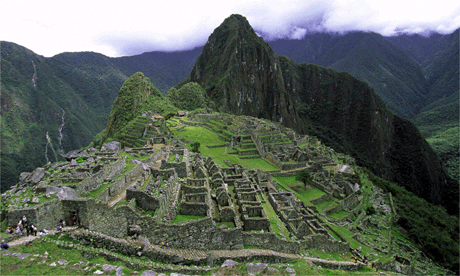
The first view of the Citadel of Machu Picchu is absolutely amazing. You cannot help but to marvel at the sight. The lost city of the Incas is built on a saddle shaped ridge slung between 2 giant peaks. Near vertical slopes drop away on either side, down to a massive bend in the Urubamba River.

P1000931

Looking down at the Citadel of Machu Picchu from the Sun Gate

P1000911

Looking up at the Sun Gate in the top left corner of the photo

Our group of adventurous women hiked up to the spectacular Sun Gate (INTIPUNKA), this is where the Citadel is viewed for the first time by those that trek the Inca Trail.

P1000865The second day visit to the Citadel saw us catch the early bus at 5.30am from Aguas Calientes, in order to experience the quiet and mystical feel of a sunrise over the Citadel. Even though the morning was shrouded in clouds, the surreal and spiritual experience was overwhelming.

Three members of our group led by our fearless leader Jose climbed the towering Huayna Picchu which is the pinnacle peak overlooking the Citadel. Pan, Sharn and Robina achieved the very steep climb to the top in 45 minutes, from where the view is spectacular.

We enjoyed a tour detailing the fascinating history and archeology of Machu Picchu, and the rest of the morning was spent walking through the ruins imagining the life that existed there. Machu Picchu should be experienced at least once in your lifetime.

P1000871 P1000652

The small town built over the Urubumba River below the mountain is called Aguas Calientes (meaning Hot Waters). It enjoys hot springs, a melting pot of people and plenty of market stalls, this was our overnight stopover.

Our journey then takes us to the bustling city of Cusco, filled with restaurants, shops, churches, museums and people from all over the world.

- signing off, Marika Martinez - Women's Own Adventure

Wednesday, October 1, 2008

Across the Andes to the Sacred Valley

On the 28th of September we flew across the Andes mountains from Lima which is on the coast to Cusco which is in the mountains at 3,000 metres.

Peruscenery From here we traveled to the Sacred valley, a most beautiful valley with the Urubumba River flowing through the centre. We had the privilege of visiting the local Sunday markets in Chinchero which has got to be the most beautiful outdoor market in all of Peru, surrounded by snow capped mountains and spectacular scenery as far as the eye can see. Both Liz and myself were fortunate enough to celebrate our birthdays in this special place.

Perumarket

The following day we visited some of the archeological sites at Pisac and Olyantambo, along the Sacred valley. There is so much fascinating Incan history all around.

peruchildren

The next 2 days were spent trekking through beautiful hills and valleys with a backdrop of mountains and the most stunning vistas to arrive at a small community village where our group of Women's Own Adventure were greeted with the warmest welcome possible. As honored guests we helped the families plant 5 trees as a memorial of our visit to their community and had a wonderful opportunity to interact with these lovely people.

peruweaving We stayed in their homes and spent time at the pre-school with the beautiful children. In the morning we trekked back to our lovely hotel in the Sacred valley to enjoy another wonderful Peruvian meal.

- signing off, Marika Martinez - Women's Own Adventure

Friday, September 26, 2008

Our Chile and Peru Adventure has begun.

A group of 10 women travelling with Women's Own Adventure arrived in Santiago ready to practice our Spanish and get into the culture of South America. After a walking tour of this beautiful city we visited the Pre-Columbian Art Museum which has the most amazing art pieces from the whole of South America.

P1000569

Today we had the pleasure of visiting the artisan market at Pueblitos Los Dominicos where beautiful arts are crafts are made by the very talented local artisans. The variety of creative pieces is amazing.

P1000574 P1000582

We were then met by our local chef who took us shopping for an array of fresh seafood and herbs for our cooking class of a mouthwatering Chillean meal. The afternoon was filled with plenty of local wine, great food and lots of laughs.

Tomorrow we leave for Lima, Peru where we will be met by Carmen and a group of small children from nearby villages. With Carmens help we are able to give gifts of clothing that we have brought to Peru for the poor families.

- signing off, Marika Martinez - Women's Own Adventure

Monday, September 8, 2008

Paddlers Complete First Descent of Peru's Upper Colca Canyon


Paddling Life has the details on the first descent of Peru's Upper Colca Canyon, which was completed on August 31st, when a team of 8 paddlers emerged from a largely unexplored, 12-mile stretch of the Upper Colca River.

Often called the World's Deepest Canyon, although there are others who lay claim to that distinction, the Colca is more than 3400 meters (11,154 feet) deep. That puts it more than twice as deep as the Grand Canyon, although the surrounding walls are not nearly as as steep.

The upper portion of that fabled and remote canyon has remained mostly unexplored, until now. According to the article, the team of adventurers were only able to run approximately six of the twelve miles they set out to conquer. Thanks to raging Class V and VI rapids, fast moving, deep water, and a surprising number of water falls, it was very slow going for the intrepid group. The remaining six miles of the canyon was said to drop another 1500 feet, with even bigger water and drops to contend with. All told, the river dropped an average of 250 feet per mile, giving an indication of how crazy the conditions were.

After spending six days in the canyon, the team eventually had to leave the water and trek their way out to civilization. Due to the slow going, the they were low on food and supplies, and decided they had to give up on their plans to run the entire section.

The trip was a big adventure, both on and off the water as well. One of the major accomplishments of the expedition was the discovery of an ancient tomb, pre-dating the Inca civilization, with eight mummies still preserved inside. This discovery made for a very successful journey, with a first ascent and a significant archeological find.

Looks like it was a great trip all around, and some of the team are already planning a return in the future to finish off the remaining section.

Friday, July 25, 2008

How Incas Split the Rocks


One technique to split stones is to drill holes, place wood in the holes, and pour water. The stone will split in a few weeks. Machu Picchu, Peru.
Photo: Szeke

Wednesday, July 2, 2008

Outside Machu Picchu


Machu Picchu is pleasant and interesting in the late afternoon. It gets to be a long day if you arrive at dawn.

Wednesday, June 11, 2008

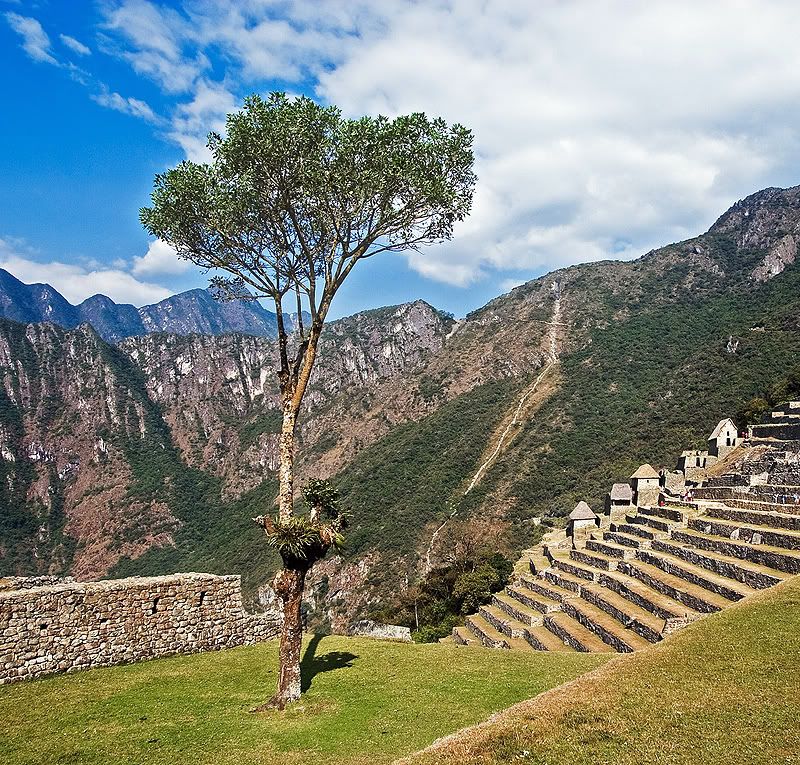
Lone Tree in Machu Picchu


This is the only tree inside Machu Picchu. It is a very privileged tree together with the Llamas. They are the only ones who can go to the grassy areas. Peru.
Photo: Szeke

Feature (Side)

© 2013 . : : Machu Picchu : . All rights resevered. Designed by Templateism