


Last week I invited readers to share their outdoor stories. With Peru's Machu Picchu gracing the latest cover of National Geographic, it seemed fitting to start with the Barauskases' adventure.
Married 47 years with four daughters and eight grandchildren, Stan and Elke Barauskas visited Machu Picchu by hiking the famed Inca trail in August 2008. He is a propulsion and power systems engineer for the space shuttle Orbiter with Boeing in Huntington Beach. She is retired registered nurse in labor and delivery.
On the second day of their hike, Elke (left) and Stan Barauskas take a break on the Inca Trail. The elevation gain was 3,300 feet and they reached 13,700 feet with snow on the ground.
Here is their story in Stan's words:
My wife, Elke, and I are longtime members of the Sierra Club and have hiked the local mountains, the Alps in Switzerland and Austria and even the Black Forest in Germany.
Of these, the four-day Inca Trail to Machu Picchu was, by far, the most challenging.
I signed on six months in advance, a typical advance reservation period since the Peru government limits access to the Inca Trail to no more than 500 people per day. That includes 200 tourists and 300 porters with no one allowed to do the trek without a guide.
In Cusco, the first impression one gets is that the Inca people were a hard-working, simple agrarian-based society. They worshipped the earth and the sun god, the moon, water, lightning, mountains and rainbows.
But after visiting the various worship sites and important structures, it was evident the Incas were proficient in engineering, architecture, astronomy, medicine and other sciences.
Their demise was partly their own doing. A major civil war broke out between the last two Inca kings, Huscar and Atahualpa. The war decimated the Incas and the Spanish took advantage of this during the Battle of Cajamarca in 1532 when they captured and ultimately killed the surviving king, Atahulapa.
Tough trek
The first day of hiking was relatively mild, only 7.2 miles and six hours of walking.
The range in age of the group was 18-69. Our fellow hikers were from England, Belgium, Canada, United States and Peru. We were accompanied by a support group of porters, Cheskis (runners) as they prefer to be called, and two local guides.
They carried all of our supplies for breakfast, lunch and dinner – and an occasional hot tea and sandwich break.
On the second day, the elevation gain was 3,300 feet, and we reached 13,700 feet. We were surprised by thunder and lightning accompanied by heavy rain.
We donned our rain ponchos and were on the trail by 7 a.m. The hike was rarely on a dirt trail. About 90 percent was on knee-jarring stones and rocks. As we gained in elevation, there was snow on the ground.
Elke and I brought thermal underwear and very warm sweaters just for this occasion. They served us well. The third day was advertised as being fairly light because the majority of the hike was downhill. This sounded great – at first. Then we found out that this day was to be the longest, both in distance and time.
Once again, we were up at 5:30 a.m. for breakfast and started our hike at 7 a.m. It was a nine-mile hike and was the first time we experienced the original trail as constructed by the ancient Incas more than 400 years ago.
Although it was true that the trail was generally downhill, it still presented some really challenging and literally breath-taking uphill sections. It was jokingly called the "gringo killer" – approximately three miles of knee-blasting downhill steps (estimated at 2,000) many of which were two-feet high with a minimum area for the foot to land on.
The younger group had little problem with these conditions. But we oldsters – and an injured young lady – made considerably slower progress. We were quite a distance away from camp when night fell.
Lucky for me, when my flashlight gave out, I had a spare bulb. There is no way I would attempt walking on a strange trail in the Andes Mountains without visibility.
With the aid of our guide, we finally arrived at our campsite after hiking approximately 12 hours. We were exhausted and ready for our hot meal, our last prepared by the faithful Cheskis.
After tips and thank yous, our guide mentioned that tradition requires that we leave the Cheskis with a song. For a moment we were all speechless. Then a quick-thinking archaeologist from Michigan suggested "Roll Out the Barrel." The Belgians, Canadians and Brits all joined in the song with gusto. It was a moment to remember.
One aspect that was not welcome for day four was the early rising, 4 a.m. The intent of the early start was to arrive at Machu Picchu's Sun Gate before the sunrise. But it started to rain, lightly at first and ultimately, a deluge.
Journey's reward
Nevertheless, we trudged on hoping for a break in the weather. Alas, it did not come.
This last portion was called a relatively mild hike, predicted to take about 2.5 hours and descending to the ruins most of the way. Although this was true, there were enough uphill portions to take my breath away and cause frequent stops.
At last, we reached our initial goal – the Sun Gate. But no sun!
The rain and accompanying clouds obscured the site.
Finally, we reached our destination – Machu Picchu. We thought our climbing was done. Far from it.
Machu Picchu is built on a series of terraces. We climbed up and down while our guide pointed out important areas. Several interesting facts were presented. One was that the site was completed by the Incas in 1460 and was the official site for Inca rulers for 100 years.
By far, it's not the largest village that the ancient Incas built – it was just the most publicized. Also, the population has been grossly overestimated. Rather than 4,000, a little more than 200 people occupied the area.
What started as a challenge and an adventure ended with my increased understanding of the Peru culture and a real appreciation for the spirit, endurance and fortitude of the Inca people and their descendants.
Rather than "conquer the trail," I learned to respect the people who had the imagination and will-power to construct such an amazing city.
Truly an experience of a lifetime.
David Whiting's column also appears News One Wednesdays, Fridays, Sundays; dwhiting@ocregister.com.
Showing posts with label Inca Trail. Show all posts
Showing posts with label Inca Trail. Show all posts
Sunday, October 17, 2010
Thursday, February 11, 2010
Inca Trail Shut Down Thru March
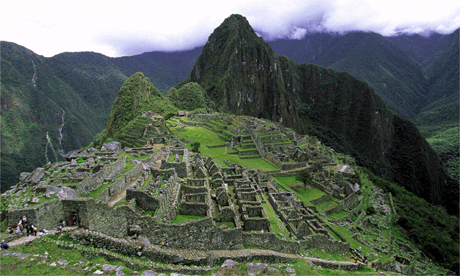
A few weeks back there was a story about how 1300 tourists were trapped at Machu Picchu following massive flooding in the area that destroyed the railway into the ancient mountain top fortress. At the time, we were told that more than 40 landslides covering the tracks and that it was damaged in multiple locations, which was preventing the famous tourist train from reaching those trapped on site.
Yesterday, I wrote an update on the situation for Gadling.com with news that the train is set to resume operation within the next three weeks, which is ahead of the eight weeks that were originally projected. Meanwhile, an alternate back route is being opened allowing travelers to visit Machu Picchu, although it requires a five hour car ride to get to the area.
Of course, many of us would prefer to make the hike to the monument via the famous Inca Trail, a four day trek through the Andes that culminates with a sunrise march into Machu Picchu. Traditionally, the trail is closed in February for repairs and maintenance, which means the current closure of the train is not effecting anyone who is currently out on that ancient road. But now we have word, via Detour Destinations Travel Blog, that the closure of the trail will extend through March thanks to the flooding in the area. The Instituto Nacional de Cultura, the agency in charge of the trail, is refunding all trail permits, and encouraging those planning on making the hike to seek alternative trekking options within the country.
This has to be really depressing news for anyone who had been planning on going to Peru to hike the Inca Trail next month. By most accounts, it is an amazing experience, and well worth the hike. I just hope that everyone who had plans will find alternatives that live up to their expectations.
Friday, April 18, 2008
Inca Trail Alternatives
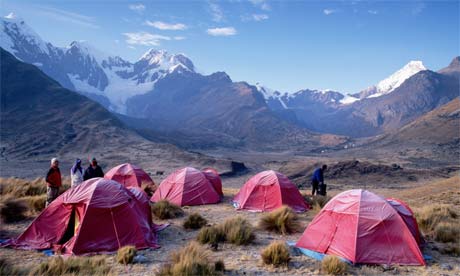
The Guardian is reporting today that the Inca Trail is sold out into September, and that the iconic South American hike will not be open to reservations until after that time. The Peruvian Government has instituted some new restrictions on the Trail in order to protect it and the environments through which it runs. In recent years the trail has continued to grow in popularity, and at times has become quite crowded, prompting the action.
Fear not though, as there are some excellent alternative hikes in the Andes that allow you to capture the same spirit of the Inca Trail, albeit with fewer crowds. The article recommends some of these lesser known trails and offers up advice on guide services for the alternative routes as well.
For example, they suggest the Salkantay Trail, which is best known as the "Back Door to Machu Picchu" as it ends at the same lost city as the Inca Trail. The Salkantay weaves it's way in and out of high passes and jungle valleys over the course of its 4 day journey. This trail is the most likely to get crowded next though, as it's the main alternative to the Inca.
Lesser known Andes treks are also provided, such as the Choquequirao, which is a longer trek matching scenery with cultural immersion, or the Cordillera Huayhuash which is located near the city of Huaraz and offers solitude and breath taking scenery as you march one of two routes near the Cordillera Blanca range.
Peru is considered one of the adventure capitals of South America, with it's proximity to the Andes and ancient ruins. Definitely a place worth exploring for a combination of trekking and culture. However, if you have your heart set on the Inca Trail, it sounds like you had better book it further ahead, or plan on going during the off season.
Friday, February 29, 2008
YouTube Video: Hiking The Inca Trail
While checking out the Friday Matinee today over at OutdoorsMagic.com I came across this cool video of a couple hiking the Inca Trail in Peru. The video does a great job of showing what the conditions on the trail are like, and it doesn't hurt that the couple in question have great senses of humor and are fun to listen to.
Today's Friday Matinee has a Peruvian theme to it, as the other videos are also set in that country. There are a couple of nice mountaineering vids centered around the Cordillera Blanca area, with some really great footage. Definitely worth checking out.
Today's Friday Matinee has a Peruvian theme to it, as the other videos are also set in that country. There are a couple of nice mountaineering vids centered around the Cordillera Blanca area, with some really great footage. Definitely worth checking out.
Subscribe to:
Posts (Atom)


