AD (728x90)

  • 2793 Pine St

    2793 Pine St

    Nulla facilisi. Cras blandit elit sit amet eros sodales, non accumsan neque mollis. Nullam tempor sapien tellus, sit amet posuere ante porta quis. Nunc semper leo diam, vitae imperdiet mauris suscipit et. Maecenas ut neque lectus. Duis et ipsum nec felis elementum pulvi...

  • 1100 Broderick St

    1100 Broderick St

    Nulla facilisi. Phasellus ac enim elit. Cras at lobortis dui. Nunc consequat erat lacus, a volutpat nisi sodales vitae. Phasellus pharetra at nulla in egestas. Vestibulum sit amet tortor sit amet diam placerat tincidunt sit amet eget lorem. Phasellus ...

  • 868 Turk St

    868 Turk St

    Nulla facilisi. Phasellus ac enim elit. Cras at lobortis dui. Nunc consequat erat lacus, a volutpat nisi sodales vitae. Phasellus pharetra at nulla in egestas. Vestibulum sit amet tortor sit amet diam placerat tincidunt sit amet eget lorem. Phasellus posuere posuere fel...

  • 420 Fell St

    420 Fell St

    Sed at vehicula magna, sed vulputate ipsum. Maecenas fringilla, leo et auctor consequat, lacus nulla iaculis eros, at ultrices erat libero quis ante. Praesent in neque est. Cras quis ultricies nisi, vitae laoreet nisi. Nunc a orci at velit sodales mollis ac ac ipsum. Na...

Showing posts with label Arctic Ocean. Show all posts

Monday, September 13, 2010

North Pole Circumnavigation Update: Racing The Ice

The two ships that are racing to become the first to circumnavigate the North Pole via the Northeast and Northwest passages are continuing their perilous journey, even as the colder weather begins to move in, and the ice starts to close for another season.

ExWeb posted an update today on the circum navigation race that is being conducted between the Russian ship Peter 1 and Børge Ousland's Northern Passage. The two expeditions are both hoping to become the first to successfully sail through both the Northeast and Northwest passages on a single journey,  thereby completing the first full voyage around the arctic circle. Both ships have cleared the fist leg of their journey and are now dealing with the NE Passage above Canada.

According to the latest updates, the Peter 1 has once again moved out in front, but the crew is beginning to get concerned about the weather reports. The forecasts call for strong, cold northerly winds that will begin the process of freezing over the passage for another year. Those conditions are expected to arrive on Thursday, although they could be more of a problem for Børge's boat which is lighter, and faster, but made of fiberglass, while the Russian vessel is made of steel and can deal with the ice a bit more easily.

ExWeb estimates that it will take roughly another two weeks before either ship clears the Passage and makes their way out into the North Atlantic. That is a long time to battle the elements and conditions, which will be changing very rapidly during that time. The voyage for both ships and their crews has been challenging already, but they're about to get a whole lot more difficult. Neither expedition is a sure thing, and they'll definitely need to stay vigilant as the ice begins to close.

It should be interesting to watch the progress of the two ships as they not only race one another but the end of the season too.

Thursday, September 9, 2010

Bear Grylls Completes Charity Expedition Through The Northwest Passage

I received a press release about this story last week while I was out of contact and off the grid. It seems Bear Grylls, star of Man vs. Wild, has just finished an expedition through the Northwest Passage in an effort to raise funds and awareness for the Global Angels, an organization dedicated to aiding children living in poverty or with other disadvantages, around the world.

Bear, and his four companions, set out on the expedition on the 28th of August, and reached their end point of Paulutuk earlier today, 12 days after they got underway. The small, and very remote village is located on Darnley Bay, on the western side of the Passage.

The team made the journey aboard a specially designed Zodiac rigid inflatable boat dubbed the Arctic Wolf.  In order to prepare the boat for the rigors of the Northwest Passage however it needed to be fitted with a special shock-aborbing counsel and seats, as well as long range fuel tanks, storage lockers, heaters, and three outboard Mercury engines. Apparently it performed very well, as Bear and the rest of the boys, arrived at their destination ahead of schedule.

To read more about the expedition, as well ad the crew's daily blog click here.

Friday, August 20, 2010

2011 Expedition Will Row to the Magnetic North Pole

Scottish adventurer Jock Wishart is planning an expedition that will take place next summer, in which he and a small, hand picked team, will set out from Resolute Bay in Canada, and attempt to row to the Magnetic North Pole. Along the way, they'll cover a distance of 450 miles through some of the harshest conditions on the planet.

According to this story, a specially designed boat is currently being constructed that will allow the team to easily drag it across the ice if necessary, as even in the summer there could be considerable ice flows to contend with. Additionally, a great deal of care is being put into reinforcing the hull and making sure that it is durable, yet light, so that it can stand up to the challenges of the ice while remaining easy to row through the water.

Wishart says that he first became aware of the idea of rowing to the Magnetic North Pole in 2007, when he realized just how much the polar ice was breaking up during the summer months. Global climate change has caused waterways to open in the arctic that didn't exist a decade ago, and adventurers are now exploring them in a variety of ways.

The Magnetic North Pole should not be confused with the Geographic North Pole, which is the one that most explorers visit during the spring North Pole season. The Magnetic Pole is where our compasses point, and it actually sits further south in the Arctic Ocean and even shifts location a bit over time. At this point, it is still impossible to sail or row to the Geographic North Pole, but if pack ice continues to melt, that may not be out of the question in the future.

Friday, June 25, 2010

Russians Challenge Norwegians In North Pole Circumnavigation Race

A few weeks back I posted a story about how Norwegian explorers Børge Ousland and Thorleif Thorleifsson were preparing to attempt to circumnavigate the North Pole by sailing through both the Northeast and Northwest Passages. Now, ExWeb is saying that they may have some competition in the race to become the first people to achieve that feat. 


According to the story, a Russian crew set off on the exact same day as Børge and Thorleif on their own circumnavigation attempt. The Russian's are sailing in a 60-foot long sailing ship called the Peter 1, which is captained by Daniel Gavrilov and his crew of six. 


The Peter 1 first sailed to Grimstad in Norway to chat with Trond Aasvoll, a Norwegian sailor who has already braved the Northeast Passage. After gaining valuable insights into the Passage, they then set sail along the Norwegian coastline and are making their way to Murmansk, the Russian city that serves as the check-in point for their first challenge, the Northeast Passage. 


If all goes as planned, both crews will sail through the region in August, and exit in time for the opening of the Northwest Passage, which has traditionally been in September the past few years. The conditions of both waterways will be important for the teams though, as while the Russian ship is designed to be more stable int he water and resist impacts better, the Norwegian vessel is small, fast, and light, and was built with the intention of flitting through the water with more agility. 


This expedition was already interesting enough, and now we have a good old fashioned boat race. A little good natured competition between the crews might be kind of fun to watch. It'll be interesting to see who gets to the finish line first. 

Thursday, June 17, 2010

More Sailing Updates: Two Expeditions Coming To An End


With all of this talk about these young girls making their solo circumnavigation attempts, it's sometimes easy to forget that there are some other great sea borne adventures that have been taking place, two of which are coming to an end today.

First up, Reid Stowe, who I've mentioned a few times in the past, is about to finish up his 1000 Days at Sea Expedition. He's actually been at sea for 1152 days, and will be pulling into New York harbor sometime today.

The goal of the expedition was to demonstrate the possibilities of making a journey to Mars, and when he began the voyage, he was hoping so simulate the conditions that astronauts could possibly face if they were on a prolonged journey. That was more than three years ago, and at long last, he'll set foot on land once again today, where he'll be greeted by hundreds of well wishers, including Soanya Ahmad, who began the journey with him, but was forced to leave after 305 days due to debilitating sea sickness. Turns out that she was also pregnant, and would later give birth to their son. Since that time, Reid has spent more than two years alone at sea.

I'll bet he'll be happy to be back on land tonight.

Meanwhile, jumping to the west coast, a few days back I posted an update on the Around the Americas Team, and how they were closing in on their final destination as well. Turns out, today will be the day for them to return home as well. The crew of the Ocean Watch should reach Seattle sometime this afternoon too, bringing an end to their 13-month circumnavigation of North and South America that saw them navigating their way through the Northwest Passage. This amazing journey has never been completed before, and while making the voyage, the crew took water samples and recorded all kinds of data to help us to better understand the impact of global climate change on the health of our seas.

I want to take the opportunity to with both Reid and the Ocean Watch crew home. Your two respective journeys have been tremendous to follow.

Monday, June 14, 2010

Around The Americas Update: Nearly Home!


I haven't really mentioned much about the Around the Americas expedition since they made their way through the perilous waters off of Cape Horn. That was back in January, and since that time, they've had plenty of adventures, as they've sailed up the west coasts of both North and South America, making their way back to where they started, Seattle, Washington. Now, they're within a few days of completing their epic journey, and finishing a sailing adventure that had never been done before.

For those who aren't familiar with the expedition, the crew of the Ocean Watch set sail from Seattle last May with the idea of circumnavigating the continents of both North and South America. Until recent years, the journey wasn't even possible, but thanks to global climate change, the Northwest Passage has been navigable for the past few years. Upon beginning their voyage, the ship sailed north, to Alaska, and began what was perhaps the most treacherous portion of the trip through the ice waters of the Arctic Ocean. Once they cleared that section, they turned south, down the coast of North and South America, around the Horn, and then back North, where they are now, more than a year after starting, and closing in on their destination.

Of course, the journey wasn't just about the adventure itself. Along the way, the crew was joined by a variety of guests, and throughout the journey, a number of scientific experiments were made, and sample were taken, to record the impact of global climate change on the oceans and seas through which they passed. When they get back home, the crew of the Ocean Watch, will deliver some very important data that could offer some great insights into the health of our oceans.

I'll post an update again when they've reached Seattle. It's been a long journey, and you can read about their experiences in their blog, which they've been keeping since the beginning, and has lots of great information and stores to tell. Read it by clicking here.

Friday, June 11, 2010

Catlin Arctic Survey: Videos Redux

Yesterday I mentioned that the Catlin Arctic Survey had posted a couple of cool, and interesting videos on their website, but that I couldn't get them to embed properly here to share them. Today they've added them to YouTube, making it a win for all of us.

The first video is an excellent look at what the Expedition Team went through on their journey to the North Pole. It combines Google Earth with the expedition's tracking data, and photographs from out on the Ice to give us a good indication of what the journey was like. It is very well done, and will give you a new appreciation for polar travel. The second video is an overview of the entire project, which is exploring the impact of acidification on the Arctic Ocean, and how that is effecting life there, and elsewhere on the planet.


Thursday, June 10, 2010

Catlin Arctic Survey: Introduction and Recap of the Expedition, On Video!

The Catlin Arctic Survey may be over for 2010, but the research into their findings is just getting underway. According to the website, the initial findings won't come until some time in the Fall, and they promise to post those findings as soon as they become available.

But for now, they've posted two great videos that demonstrate what the program is about, and what their goals were for the expedition, namely to get samples of the arctic water and test its levels of acidification. Their findings should speak directly to the current health of our oceans and the effects that we are having on it.

Update: For some reason, I'm having issues getting their embedded videos to work on my page. So, to check them out, click here.

Tuesday, June 8, 2010

World Oceans Day: Save Our Planet, Save Ourselves


Today is World Oceans Day, and considering what is happening in the Gulf of Mexico at the moment, it seems fitting to stop and reflect on what we are doing to our seas, and how that effects the rest of the world.

We've known for some time that the health of our oceans has a direct impact on the health of the rest of the planet. The oceans are the engines that drive the air currents and weather patterns that have long term, and lasting effects on the environments around us, and yet we seem to have neglected them for too long. The Great Pacific Garbage Patch is a depressing example of how we have treated the oceans as a dumping grounds, and it is scary just how much crap has accumulated out there. All of that garbage is contaminating and killing off fish at an alarming rate, and yet we seem powerless to do anything about it.

Of course, the massive oil spill that has been going on for more than six weeks in the Gulf of Mexico is just another example of how poorly we have treated the oceans. The oil that has been spewing out of that hole in the Earth has has created an environmental disaster of unprecedented proportions, and we're now told it will take years to clean it all up. Worse yet, today we got the news that the oil is not just on the surface as we had first believed, but is now being found in low levels under the water as well. Meanwhile, endangered turtle species, untold numbers of fish, manatees, birds, and other creatures are all at risk, as the oil continues to spread further eastward.

Environmentalists keep telling us that we need to change our ways. That our lifestyle is destroying the planet. But that is, once again, very short sighted. We're not destroying the planet, we're destroying ourselves. The Earth has survived far worse than what we can throw at it, and the sooner we realize that, the better we'll be. A better, more healthy, and environmentally sound approach to our own lives will lead to better, more healthy world as well. It's as simple as save our planet, save ourselves.

Tuesday, June 1, 2010

Circumnavigating The North Pole


Polar explorer Børge Ousland is joining forces with his Norwegian countryman Thorleif Thorleifsson to attempt to become the first men to sail around the North Pole, something that has not been possible in the past, but is now thanks to global climate change.

The explorers plan on setting out on June 21st, sailing east to west through the Northeast passage, which traditionally opens to traffic during the month of August. That treacherous sea route falls in the Arctic Ocean to the north of Russia. Once they have successfully navigated through that portion of their trip, Børge and Thorleif will will continue east towards the Northwest passage, another icy and dangerous route that opens up through the Arctic Ocean above Canada. That route opens in September.

These two routes had been sealed off to ships for centuries, with a thick ice pack preventing anyone from being able to sail those waters. But as global warming continues to have an effect on our planet, the ice in the Arctic Ocean has become less stable. As a result, the Northeast and Northwest Passages have both opened up for brief periods of time in recent years, allowing adventurous travelers and explorers to navigate through those ice waters.

The Norwegians will be sailing on a small boat designed to be quick and maintain a good pace in variable conditions. The ship isn't designed to break through ice however, nor does it allow them to carry much in the way of gear and supplies, adding an element of danger to the expedition. Furthermore, they'll need to rely on satellite imagery to chart their course through the two Passages, as the ice will break up in irregular patterns and the open channel may not be as obvious at it would seem.

ExWeb points out that a similar voyage was attempted last year by a different team of Norwegians, but that crew failed in their objective thanks to Russian bureaucracy. The ship was detained while crossing through the Northeast passage due to a lack of the proper paperwork, and by the time they were allowed to go on their way, the Northwest Passage had already begun to close. Lets hope Børge and Thorleif have better luck.

Wednesday, May 12, 2010

Catlin Arctic Survey: They Did It!! Explorers At 90ºN!


We've been following the Catlin Arctic Survey Team for 60 days now, and after some very long, and hard days out on the ice, the word has just come through that the Explorers Team has, at long last, reached the North Pole!

As you probably already know by now, the team consists of Ann Daniels, Charlie Paton and Martin Hartley, three veteran polar explorers. The trio has been making their way north for two months now, and along the way, they have been taking samples of the water in the Arctic Ocean to track the acidification of the water, and the effects of high levels of carbon dioxide on the ocean. Today, they took their final sample through a "Hole at the Pole", bringing an end to their journey.

Setting out on March 14th, Daniels, Paton, and Hartley covered 483 miles on their trek to the Pole. They also had to pick up their pace, and increase their daily distance, in an effort to reach that point before the end of the arctic season, which is usually marked by the break-up of the ice as the warmer months set in. The team also battled extreme cold, whiteout conditions, large open leads, and lots and lots of negative drift along the way. To say that they are ecstatic about reaching their goal is probably an understatement. They are now the last team out on the ice, and will be retrieved sometime in the next few days.

Once they do return home, their water samples will serve as the baseline for some important new research on the effects of global climate change on the polar ice caps and the water underneath. Future expeditions are likely to take similar samples, but they will all be compared to the ones this team has gathered. It is a testament to their determination and stamina that they were able to reach the North Pole while still collecting all of their samples as well.

Congratulations to Ann, Charlie, and Martin on a job well done. Get some rest team, you've earned it.

Monday, May 10, 2010

Catlin Arctic Survey: Past 89º, Still Heading North


While the Arctic Season is over and done with for the most part, the intrepid trio that make up the Catlin Arctic Survey's Explorers Team are still out on the ice and still heading towards the North Pole, even as they face more negative drift, wide open leads, and a race against the clock.

Yesterday was a very long, and tiring day, for the already exhausted team. Team leader Ann Daniels, along with polar explorers Martin Hartley and Charlie Paton covered more than 12 miles, only to give more than a mile and half back over night, thanks to negative drift. As of their last recorded position, the team was sitting at 89.29ºN, butting them so close to the Pole they can almost taste it, but with still quite a few miles to cover before they are done.

The team has now been out on the ice for nearly two months, and that has begun to take a physical and psychological toll. There is no doubt that they are all very tired, but remain committed to reaching the top of the world before they go home. In their latest report, the team talks about the caloric imbalance they've had to deal with while out on the ice. It is estimated that they are burning somewhere in the neighborhood of 12,000 calories per day, but are living on about 6000 calories per day. Over the course of their journey that means a significant loss of weight and energy, while they battle to stay focused and on target with their goals. The update also says that they could end up losing as much as 10% of their body weight and have essentially zero fat when they have completed the expedition.

Meanwhile, despite all of that, and the long days out on the ice, the team has not lost sight of their mission. In addition to reaching the North Pole, they still continue to collect ice samples which will be scrutinized closely upon their return to examine the levels of Carbon Dioxide present in the Arctic Ocean as part of a larger effort to determine how global climate change is effecting the polar ice caps. This is something that the Ice Base Team, the second arm of the survey, was working on before they closed up shop and went home for the season.

Speaking of which, it now appears that the Explorers will continue on to the North Pole no matter what. They'll be retrieved from the ice once they complete their journey, but it is now getting very late in the Arctic Season, and the ice is breaking up significantly at this point. Hopefully that will not have an impact on the ability for a rescue plane to come get them once they are at 90ºN. If they keep going at their present speed, they should reach that point in a matter of days.

Friday, April 9, 2010

Catlin Arctic Survey: Ice Conditions Remain Unpredictable, Research Progressing


The two teams that make up the Catlin Arctic Survey team continue to have very busy and eventful days in the arctic. The explorers are continuing to make their way north, amidst some of the strangest and most dangerous ice conditions they've ever seen, while back in the Ice Base, a new group of scientists are hard at work.

The Explorers team is made up of polar vets Ann Daniels, Martin Hartley and Charlie Paton, and their mission to take samples of the arctic ice while making their way to the North Pole. Presently, they're at roughly 86.34ºN, and contending with, quite literally, constantly changing ice conditions. The has been so unstable in fact that one morning during breakfast the trio heard it cracking all around them outside of their tent, and they were forced to evacuate their shelter, and quickly decide which side of the crack they wanted to be on, pulling gear and sleds along with them in order to avoid catastrophic damage. Charlie Paton described the scene like this, “We heard a crack, a few bangs and then suddenly the ice started to break apart. It all happened very quickly and was unlike anything I’ve experienced before"

This wasn't the only dangerous situation they've found themselves in either. One day, while navigating through the ice flows and around open water, they actually found themselves surrounded on all sides by ice that was too thin to cross. It was a sobering reminder of how quickly things can change in the arctic. Check out this amazing video that the team captured that demonstrates just what kind of conditions they are dealing with on their long, cold journey to the top of the world.

It hasn't been all bad for the explorers though, as they received their first resupply this week, providing them with some much need fresh food and gear. The team remains confident and upbeat that they'll arrive at the Pole on schedule.

Meanwhile, back at the Ice Base the scientists continue their work, which included a little home improvement, including an update and improvement to the loo. Of course, they're continuing their valuable research on the effects of CO2 in the atmosphere on the Arctic Ocean, with Laura Edwards, of Bangor University, who has been at the base since Day 1, providing an update on the process. The research team has been happy to find a wide variety of life thriving in the water, including plankton, tiny crustaceans called copepods, and lentil-sized sea snails called pteropods.

Finally, click here to meet Brownie, the Ice Base's early warning system for polar bears. Brownie is a part-Husky, part- German Shepherd mix who is always on watch for the big, hungry white bears that are common in the area. Brownie also earns her keep by pulling a sled for the scientists as they go about their daily chores, and in turn, they've become quite fond of the four legged member of the team.

Friday, March 26, 2010

North Pole 2010: If It's Not One Thing, It's Another


The polar explorers are finding plenty of challenges in their struggle to make progress in a northerly direction. For some, they continue to battle negative drift, while for others, the drift seems to have lessened , but now it's back to rubble fields and a new twist, whiteout conditions.

Whiteout is exactly what Amelia Russell and Dan Darley faced today as they began their daily trudge. Amelia reports "zero visibility" on their trek, and they were immediately faced with a 30 meter lead, which made the going tough right off the bat. They had set a goal or hitting 9 nautical miles, and were able to achieve 7.7 despite the adverse conditions. The good news is that the drift seems to have subsided, and they woke up in the same position today that they went to be last night. Not losing ground is major progress at this point.

Speaking of being frustrated with negative drift, Eric Larsen's comments give an indication of just how bad it has been for the teams. A few days back he mentioned that he, along with teammates Antony Jinman and Darcy St Laurent, had crossed the 85ºN mark FIVE times thanks to their on going battle with negative drift. They believe they have crossed it for the last time though, and now feel a bit better about their progress, having only drifted 27 feet to the south last night. But while the drift has subsided for now, they have had to endure long swims in the Arctic Ocean, yesterday they were out on the water for over an hour, and have had to struggle through rubble fields and around big leads. Still, they're making positive progress, and happy about that at the moment.

Solo explorer Christina Franco has had similar challenges the past few days, waking to whiteout conditions yesterday, and facing a vast rubble field today. At this point she is still more than 300 miles form the Pole and reports that she is exhausted. Drift continues to be a problem for her, and she has yet to cross 85ºN, but she remains upbeat on her audio dispatches, as she continues to tackle one problem after another. She's not giving up on her dream of becoming the first woman to make it solo to the North Pole, but she knows that progress needs to improve soon for that to become a reality.

On the other hand, Aussie Tom Smitheringale seems to be moving along quite nicely at this point, and has found his groove. His frostbitten fingers aren't giving him as much trouble as they were a few days ago, or at the very least they aren't getting any worse, and he reports that he has come across some large, expansive pans now, which are flat, open areas that make progress north much, much easier. If these pans hold out, he'll pick up speed quite quickly, and cover good ground. It is what every polar team is hoping for at this point. Tom also reports that he gets through his days dreaming of his home and Fremantle, and all the great food he is going to eat when he returns.

A few days back I reported that Ben Saunders was preparing to hit the ice, and begin his attempt at the speed record to the Pole. He hoped to cover the distance in just 30 days, but those hopes are dashed now, as the word from his home team today is that Ben cracked a fuel canister a few days back, and the fuel melted through the food containers, contaminating more than 70% of his food. The plan was to go unsupported to the Pole, and Ben doesn't want to make the journey any other way, so he's now on his way back to Cape Discovery, where he'll get a pick-up once the weather clears allowing a plane to land. Once he's back in Resolute Bay, he'll reevaluate the situation and determine if he can restart the expedition. You may recall that Ben made a similar attempt on the Pole back in 2008, but had to abandon that expedition when his skis broke down.

Stay tuned for more news from the Arctic. With teams finally starting to clear the drift zone, hopefully speeds will begin to pick up, and we'll start seeing positive progress on all fronts very soon.

Thursday, March 25, 2010

Catlin Arctic Survey: "Weirdest Weather Conditions Ever"


The Catlin Arctic Survey Explorers Team is experiencing some very challenging and unusual conditions, even by Arctic standards. Team leader Ann Daniels went so far as to describe it as the "weirdest weather conditions ever seen" by the highly experienced team. Daniels is joined by Martin Hartley and Charlie Paton on a journey that will eventually lead them to the top of the world and the North Pole.

The team has been inching along over the past few days because the ice is behaving in unusual ways. Daniels says that it is "constantly moving, breaking and shifting," and "bending, bouncing and wobbling" while the intrepid trio passes over it. As a result, the team hasn't made much headway the past few days while the move through a patch of ice that is unstable at best.

The Catlin home team, based out of London, says that it is a "combination of fast moving ice, large amounts of open water and a continual breaking up of ice floes splitting and rucking up right in front of your eyes, hour after hour for days”. Polar explorer Pen Hadow, who was part of the team last year and is now serving as the Director for the program, says that he hasn't seen anything like it in his years of polar exploration. An unusual weather pattern, which has delivered constant, steady winds from the north is being blamed for the thinner ice that is disrupting travel for the Catlin Team as well as other explorers in the area.

Perhaps most disheartening is the strong negative drift which is preventing them from making much progress. According to a press release from the team today, the Explorers Team hit the ice back on May 14th and should have covered more than 53km by now. Thanks to negative drift however, they've only managed to gain 5.5km.

This year's survey is broken into two teams, and while the Explorers head north, collecting ice samples as they go, the Ice Base Team is made up of a group of scientists and researchers who are staying in one place and taking their own samples from the ice and saltwater found underneath. That base is located in the Nunavut territory of Canada, and will serve as a scientific research station while the team remains in the arctic.

Monday, March 22, 2010

North Pole 2010: Tracks In The Snow and A New Expedition Begins!


The weekend brought plenty of challenges for the polar explorers who are struggling to make headway with a brutal negative drift working against them and conditions on the ice remaining very difficult. And as those already out on the ice continue to make their way north, a new expedition is set to begin tomorrow.

Just when we thought that all of the arctic teams had set out on their journeys, a new solo expedition prepares to hit the ice tomorrow. British adventurer Ben Saunders is packed and ready to go, and tomorrow a Twin Otters airplane will drop him on the edge of the Arctic Ocean, where he will begin his solo, unassisted, attempt at a speed record to the North Pole. He hopes to complete the expedition in just 30 days, and to do so, he'll have to be really moving. Saunders attempt this speed record back in 2008, but was forced to abandon his quest when his skis were irreparably broken. Can he make it this time? Stay tuned to find out!

For those already out on the ice, it was an extremely trying weekend. Take for example Tom Smitheringale, who faced negative drift so bad that it effected the ability of his satellite phone to stay connected when he called his home team. One morning he woke up to find that he had slid nearly 3 nautical miles to the south of his position when he went to bed that night. He faced a similar proposition the next night as well. He also is reporting that the cold is starting to get to his fingers, with a couple of them turning black, in what is sure to be an ominous sign at this point of the expedition. Let's hope they don't continue to deteriorate. Tom also received a bit of a shock when he came across the tracks of another explorer out in the snow. Seeing the signs of another living person was unexpected and a bit jolting too.

Christina Franco also had a rough weekend, facing similar levels of negative drift and large leads of open water. Fortunately, things got better for her today, as she received a supply drop, and took the day off from pulling her heavy sled in order to re-pack her gear. She reports that she now has a renewed energy, and is prepared to get back on the trail tomorrow in her efforts to become the first woman to go solo to the North Pole.

Continuing the theme of on going misery, Eric Larsen and his team have had an awful few days too. Eric reports that he not only hit bottom, he fell through that false bottom and fell even further, after he pulled three straight shifts as navigator for the team, leaving him out in front, and breaking trail. As you can imagine, this is quite physically demanding, and when Eric hit the tent that night, he felt like he had the flu, with his body weary beyond anything he had experienced before. The next day wasn't much better, but he continued to trudge forward none the less, although he admits to putting his head into his mittens and letting out a few sobs of frustration over the fact that he felt so terribly weak and tired, and was seemingly making little to no headway thanks to the persistent negative drift. Something that he calls the Polar Treadmill, and the Save The Poles Team aren't the only ones to use that term in the past few days.

In fact, Amelia Russell and Dan Darley have said the same thing as the negative drift has had them moving in reverse the past few days too. They have been averaging between 7 and 8 nautical miles per day, but have been sliding backwards at a rate of about .1-.2 nm as well. As a result, by the time they climb out of the tent in the morning, they don't have a lot of positive gains to show for their work. While this has been extremely frustrating for them, they seem to be remaining fairly positive and upbeat in their approaching, redoubling their efforts to work towards gaining ground.

Richard Weber, along with Tessum Weber, David and Howard Fairbank, continue to plod along northward as well, although they had their first swim over the weekend, having to plunge in the ice waters of the Arctic Ocean in order to cross a 150 meter wide lead. That took an hour over come, and they were happy to have that experience behind them. Also, if everything went according to plan, they should have received their first supply drop yesterday, and their once light sleds should now be heavy, and full with gear and supplies once again. They were most in need of fuel and food, and by all accounts they should be good to go for another couple of weeks.

Finally, the Catlin Arctic Survey Team had to batten down the hatches over the weekend as a massive storm moved into where the Ice Base Team is conducting research. The cold front brought -45ºC Temps, and 60 mph winds, making it feel like it was -75ºC out there. Brr! Meanwhile, the Explorer Team has been out for more than a week now, but are making very slow progress thanks to high winds and the same negative drift that has been plaguing the other teams. Still they remain in good spirits and are conducting important research as they go.

Good luck to all the teams out there. Stay the course, remain positive, and you'll get past this negative drift soon enough and on to solid ice that will let you go north without all the frustrations. Hang in there!

Friday, March 19, 2010

North Pole 2010: "We Are Tired"


It has been another busy week in the Arctic, where polar explorers continue to have very tough going, facing large, and very daunting, icefields and big leads, which are areas of open water that must be navigated around or swam across so that the teams can continue to make progress. As is typical for the early start of the season, it is very challenging, but things actually get easier, and mileage picks up as they get further north.

One team this is definitely having a rough go this week is Eric Larsen's Save The Poles Expedition. Eric is joined out on the ice by Antony Jinman and Darcy St Laurent, and according to their most recent updates, this has been a very long and tiring week. Antony has been struggling with an injured knee, which isn't quite back up to par just yet. They've had to deal with all the usual stuff that I mentioned above, plus inclement weather. At one point it was so cold, they had to huddle behind ice blocks to stay warm. They have had to remind themselves on more than one occasion why they are out there, and they end their last dispatch with the very ominous line of "We are tired."

Amelia Russell and Dan Darley were reminded today about how fast and unstable conditions can be out on the arctic ice. At one point they came across two ice sheets crashing against one another, with one sliding across the other at a speed of a foot a minute. Later, Amelia fell through the ice up to her knees, so her gear needed to be dried out. In the conditions they are traveling, wet gear stays wet, and frozen, for some time. The two Brits covered six miles today, but also report that they were battling negative drift throughout, with at least three occasions were they were well aware that the ice was moving them backwards. Very frustrating and difficult to be sure.

Christina Franco sounded very cheery on her latest audio dispatches, but her voice didn't match how long and challenging her day was. She started things off with a rather tough icefield, which gave way to what she describes as a "gigantic lead" which caused her to go an hour and a half out of her way in order to continue moving north. Eventually she did find a way around, which made it all work out in the end. She said that the cold winds continue to persist, forcing her to don extra gear to stay warm, but on a positive note, the days are getting noticeably longer, which is making it easier to get up and moving in the mornings without the need of a headlamp in the tent. Right now the explorers are experiencing roughly 12 hours of sun per day.

Australian Tom Smitheringale continues his solo and unsupported journey north as well. He's now been out on the ice for more than 18 days, and while progress has been, at times, quite slow, he remains in good spirits, and is happy to be where he is, despite the incredibly difficult conditions. Temperatures have been hovering around the -30ºF mark for the past few days, and with cloud cover setting in, there hasn't even been much sunshine to help brighten the day. Still, it's all about moving forward as best you can, and it seems Tom is doing well in that department, calling on his past experiences and knowledge to get him through the challenges of the early part of the expedition.

Finally, the Catlin Arctic Survey Teams are both off and running. The Explorer Team hit the ice on Sunday and have been making their way north ever since, collecting ice samples and other data as they go. Meanwhile, the Ice Base Team, which consists of a group of scientists, was dropped at their location as well, and they'll now begin collecting data too. The scientists who will be spending the next several weeks conducting research on the impact of climate change on the arctic include Helen Findlay (Plymouth Marine Laboratory); Ceri Lewis (University of Exeter); Laura Edwards (Bangor University) and Glenn Cooper (Institute of Ocean Sciences, Fisheries and Oceans Canada). These lucky four will have all the joys of living in the Arctic, including the -40º temperatures, without the joy of actually going somewhere. It's going to be a very long season for them.

Thursday, March 18, 2010

Ocean Rowing: Through The Northwest Passage!


I've covered a lot of ocean rowing adventures, including Roz's amazing trans-Pacific row, Katie Spotz's recently finished trans-Atlantic expedition, and Olly Hick's attempt to circumnavigate around Antarctica. Now, we've got another big ocean adventure that is sure to be quite the challenge, not to mention risky and dangerous.

According to ExWeb, French rower Mathieu Bonnier is preparing to row the length of the Northwest Passage, starting in the Atlantic Ocean, traveling west, and eventually ending in the Pacific, while navigating through the treacherous and icy Arctic Ocean. Mathieu will set out from Greenland this summer, and will row as far as he can before the weather turns bad. He'll then wait out the long, dark, and cold Arctic winter, returning in 2011 to finish the rest of the voyage.

Obviously an expedition like this one could not have been contemplated just a few years ago. But with global climate change causing all kinds of odd things to happen, the fabled Northwest Passage has been open for travel the past few years, with a number of ships making the journey. What was once unnavigable thanks to frozen waters and giant blocks of ice, is now open, at least for the summer months, allowing explorers to visit a part of the Earth that was mostly off limits before. Bonnier will take advantage of those conditions to make his row.

Pretty impressive stuff if you ask me. Should be fun to follow along this summer and next.

Monday, March 15, 2010

North Pole 2010: Teams Hitting Milestones!


While the arctic explorers are finding it tough going thus far, they are finding inspiration in small victories, as they begin to hit their first milestones on their journey to stand at the top of the world.

First up, we have news that Amelia Russell and Dan Darley hit the 84º line over the weekend, marking the completion of their first degree on the long journey to 90-North! They have set a goal to reach the Pole in 45 days, and are hopeful that they can accomplish that task, but know they have a long way to go before they do. Still, they've been surprised at how good the conditions have been for them so far, and are pleased with their progress. Today the British duo managed to knock off 7.4 nautical miles in 9.5 hours of skiing, which seems like a lot of work for the distance gained. But, all of that hard work will pay off in the end when the ice will be smoother and they'll be making much better time.

Eric Larsen and his team are now 12 days out, and reportedly hit "Polar Paydirt" yesterday when they found their way around a lead, and had nothing but solid, flat ice in front of them, meaning they could don the skis for the first time in awhile, and start making positive progress with a bit less of an effort. As is typical in the arctic however, the good ice didn't last, and they were back to snowshoes soon enough, but they were happy for the respite, however brief. Their last reported position was at 84.12ºN, leaving them roughly 347 miles to the Pole.

Australian Tom Smitheringale is making this epic journey solo and unassisted, and has continually had equipment issues since he set out. Yesterday he broke another ski pole, his second in three days, and that has caused him some dismay over the choices he made when selecting gear. Fortunates didn't exactly improve today when he found himself facing a massive ice field with no discernible route through the rubble, which made for a very long and challenging day out on the ice. He covered about 4 kilometers in rough going.

It was a rough day for another solo explorer, as Christina Franco reports that she spent much of the day falling and struggling over the ice, while dealing with rubble. She battled one final ice field to end the day, but now has hard, smooth, open ice in front of her to start the day tomorrow. After a tough day today, she appears to still be in good spirits, and is looking forward to an easier beginning to her journey tomorrow.

Finally, The Catlin Arctic Survey 2010 Team have completed all of their prep work, and set out today from Resolute Bay for the Arctic Ocean. They were dropped just above 85ºN, where their Ice Base Team will begin to set up camp, with the Explorer Team, consisting of Ann Daniels, Martin Hartley, and Charlie Paton, going on to the Pole, collecting ice samples as they go. The team was delayed in setting out due to lost gear, bad weather, and delays to flights, but are now happy to be on their way and working on their very important mission.

Tuesday, March 2, 2010

North Pole 2010: Tom Begins His One Man Epic


The North Pole Season officially got underway in the past couple of days with some of the explorers finally getting out of Resolute Bay and hitting the ice, while others continue to prepare and wait their turn. The weather window opened briefly, and the expeditions that are underway are already dealing with the harsh Arctic conditions.

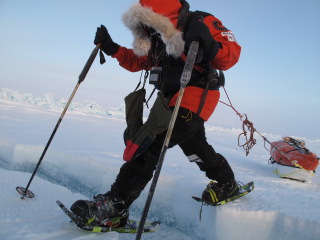
Australian Tom Smitheringale was delivered to Ward Hunt Island on Sunday, and has already been out on the ice for for a couple of days. According to his blog, he made minimal distance on his first day out, but took advantage of the time to begin to get acclimated to the terrain and cold weather, before setting up camp for the first time. On his second day, he encountered one of the great challenges to Arctic travel in the form of a large ice field which impeded his progress with large blocks of ice ranging from the size of cars to the size of houses. According to his home team, it was nearly impossible for Tom to make headway while pulling two sleds, so he was forced to drag one at a time, then return for the other, in essence covering the same ground twice. Because he is going solo and unsupported, both sleds are needed to carry all of his gear and supplies. (By the way, the photo is of Tom on his first day out on the ice. Welcome to the Arctic!)

Meanwhile, Dan Darley and Amelia Russell have run into a completely different kind of obstacle, but one that is no less challenging and dangerous. The two Brits who are making the journey to the North Pole via Cape Discovery experienced a large open area of water that they would be forced to either go around or cross. They contemplated making the crossing in their immersion suits, but after a quick dip in the water, they decided best to try to skirt around the edge. Their patience proved worthwhile, as they found solid ice that allowed them to get moving north once again, although with the open water left behind, they're already dealing with ice rubble as well, and using the process of "double hauling" to move their sleds too.

As for some of the other expeditions, they're preparing to get underway at last. Christina Franco was scheduled to be dropped off on the ice today to begin her solo and unassisted journey to the North Pole, while John Dowd, who is part of the Irish North Pole Expedition, were expecting to go yesterday, but were delayed due to bad fog. Seems like no one is going out today though, as Eric Larsen is reporting that weather has once again grounded the planes, so they'll all play the waiting game, and hope that they can get underway soon.

Feature (Side)

© 2013 . : : Machu Picchu : . All rights resevered. Designed by Templateism